Pattern Pulp

Social Media: Tag, you’re it!


Ahh, the good ol’ school days where slapping someone on the back during recess gave them the opportunity to slap someone else. Well, tagging these days has matured from playgrounds to the web-interface, but it has maintained it’s most fundamental element: its social counsel.

What, you may ask? How did a semi-violent, super competitive child’s play transform into the Web 2.0 system of classification system? Truth be told, it didn’t; yet, the game of tag identifies someone as a leader of a social context (even if you were super fast in Pre-K and immediately purged yourself of being ‘it’) and tags today identify information as important through a social media context.

Tagging, which we have all come to know, love and ubiquitously use, is a Web 2.0 (or semantic web) ontological system of classification system. Yikes, that sounds scientific jargon heavy.  Basically, remember the ancient days of clunky Netscape and the Internet Bubble Burst of 2001? Well, after many dot com-ers saw their dreams being crushed, some intrepid programmers, who weren’t ready to give up, revolutionized the Web platform. More specifically, a man who is still a preeminent web innovator today named Tim Berners-Lee created an interface system that incorporates artificial intelligence to make humans and computers understand the same language (hence the semantic part).  For Web 2.0 to work seamlessly, bits of information have to be classified by a controlled set of vocabulary that humans determine and computers understand; these are known as ontologies.  And for those of us who suffered through freshman-year Philosophy of the Mind, ontology should ring a bell as the study of existence.

The geek in you cares about web 2.0 because it is the reason why we have smart phones, cloud computing, Google and Facebook. Web 2.0 allowed thousands of us to make web pages, start blogs and create social networking spaces (raise your hand if you were on Friendster!); the onslaught of content on the Web made its organization rather difficult to keep orderly and well, necessity is the mother of all invention, right? Say hello to the Tag. They started as bookmarks on del.ici.ous and spread like wildfire with the emergence social software sites, such as Flickr, YouTube, blogs and now, Twitter.  The reason? For the people, by the people.  Tags are user-generated, community-driven classification labels that do not rely on traditional methods of taxonomy or The-Man telling you what’s important.

Tags are written in the speech of the community it reflects and promotes information that the community deems as necessary, essential or just plain freakin’ funny.  Don’t take it from me; entire IT university departments have conducted research on this very particular topic and have repeatedly demonstrated that tags are the voice of the people.  But, tags actually go deeper than that, I say.  In fact, keywords chosen for tags offer a personal reflection and analysis of the presented information— no, not some Freudian deconstruction of the matter at hand, but rather a counsel or phenomenon deeply embedded in to our culture.

Many of us when we tag our blogs, Flickr or Tweets have been known to just slap on a tag like ‘art’ or ‘pretty things’ or ‘funny’ but even those tags reflect values of our culture.  As our lives become more and more enmeshed in the Web interface (just look at the prevalence of social media as business mechanism or the fact that Obama tweets…), tags refer to staple cultural proverbs, anecdotes and other defining phenomenon.  The ones from the days before the Internets– the values of our culture that no semantic ontology can recognize, even if it can ‘understand’ the words.  My M.A. writing professor always said, “information dies on the page” (although, I’m sure he stole that from cultural theorist Walter Benjamin), but tags are a parting memento, a stamp of our values in the web-o-sphere. It’s as if tags are storytellers or the new oral tradition a la Homer or the wandering Minstrel.

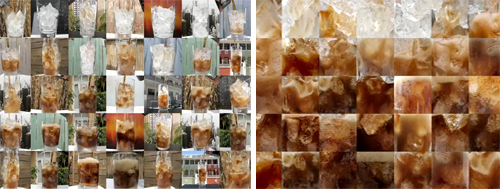
Now, this may sound entirely loony, there has been a prominent trend, one hard to ignore. If you don’t believe me, here are few examples:

We live in an information-rich, real-time mentality these days; most of us toting a Blackberry or an iPhone, constructing the future as our own and quick to forget the past. So, while no computer or code-program can ever understand what “kids these days means” or “you can run…”, they will enable the permanent storage of those sayings.  Tags can always draw us back to the lessons and values (even wives-tales!) instilled in us during childhood, the very ones we probably overheard while playing tag.

Coverage by: Julie Baumgardner
Follow-up: Spin It, Web Cam Style


Oh, the proverbial question: Which came first, the chicken or the egg? The debate can go around and around. Much like the debates of who inspired whom, what inspired what, and where on earth do ideas come from. And of course, how do they become adopted by society and wind up as trends.

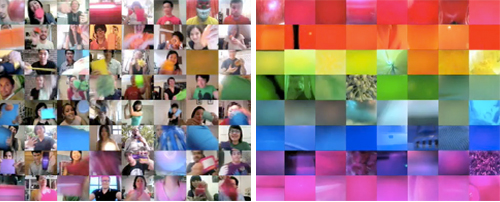
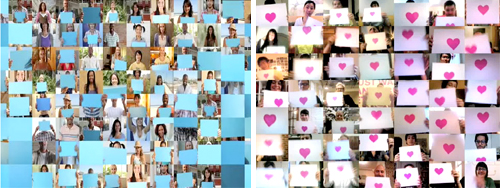
Because, we think we called it via our Interior Design Takes a Spin feature: people, they like change. They also like pixels. And in this case, web cams. We recently spotted Pepsi’s Refresh Project, One People tv spot, where a variety of people on their web cams interact with one another. Each paper conveys a pixelated vibe, and as objects are “magically” passed between squares, the concept is unified as global sharing. Naturally, we delighted at the synchronicity to our fun interior finds. Of course, in that ad’s comment section, we were then led to the Japanese band, Sour’s music video, Hibi no neiro” which has a very, very similar idea and was posted in July before Pepsi’s ad was released.

It’s speculated that Pepsi was heavily inspired by Sour’s music video which involves using the band’s fans in a fun series of web cam adventures. It’s not impossible to find other videos using a similar concept, though not necessarily as well executed as these two. In fact, watching these videos sparked the thought of another web sensation, Chat Roulette, where anyone can log online and through their web cam talk to people from around the world. They can switch to someone else quickly just by pressing a button. It’s Spinning It: People Style.  Maybe they’re all inspired by our increasing hunger for the new and the next, the impatience it inspires, and our desire for change. Now.

Coverage by: Emily Gup

Interview: Matt W. Moore


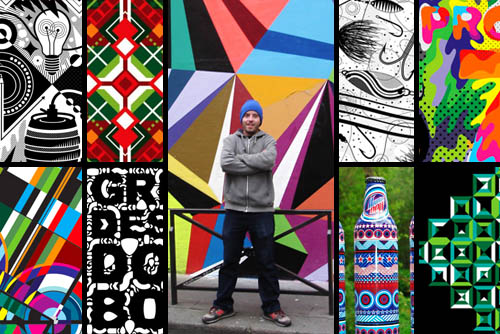
It’s no secret that Matt W. Moore’s vectorfunk graphics are single-handedly influencing an entire generation of artists. His fusion of graffiti, graphic design and watercolor are upbeat, intricate and extremely brand friendly. His work has appeared in countless magazines and print campaigns, from Nike and Burton to Wired and Mountain Dew. Moore’s Design and Illustration studio, MWM Graphics, is based in Portland, Maine and exhibits in galleries throughout the world, collaborating with clients from all sectors. Moore is also Co-Founder & Designer for Glyph Cue Clothing. Check out our Q+A for a glimpse into MWM’s daily routine!

*            *            *

PP:  What websites and news sources do you generally start your day with-do you have a daily routine for news/blog/information consumption?

MWM: I get at least an hour a day of Cyber Surfing in while I enjoy my morning coffee. Some of the websites I frequent:

PSFK
Format Magazine
FFFFOUND
Not Cot
Rojo Magazine
The KDU
Hype Beast

The list goes on. More and more lately, I find myself skimming my carefully curated list of Twits on Twitter. Less time scouring blogs, and more time surfing suggested links.

PP:  How did you discover your talent and how has it evolved over your creative career?

MWM: I’m not comfortable with the term “discover” when referring to talent. I’ve worked damn hard, and I have boxes full of sub-par art and design from my past to prove it. I prefer to think of it more as “nurturing” my vision and dreams. Hard work pays off. As for “evolution”, it is a constant evolution. Everything is always in flux. New ideas, new techniques, new knowledge, new dreams. This is why it is so exciting to be an artist and work as a creative. Everyday is a new adventure!

PP: Please explain your design process when approaching a new concept or product line.

MWM: My process is different for every single project, but a few things are constant. It always starts out with a dialog to make sure I understand the client’s objectives and vision. Then we draft a brief and timeline together. Then I do an exploration phase yielding multiple options. We review and open a new dialog. Then I continue working and refine, finesse, and finalize the design.

PP: What is your preferred method of design and how is it incorporated in your final product? (ie. collage, computer, handwork, etc.)

MWM: The majority of my commercial design work and apparel/textile/product graphics are created entirely with vectors in Adobe Illustrator. Some days I spend over 12 hours lost in this Vectorfunk World. It is my playground.

PP: When is the last time you took a professional/creative risk? Please explain.

MWM: Every single creative decision an artist makes should be a “risk”. If they aren’t taking risks, they are not an Artist, they are a Tradesperson. That said, a couple recent risky decisions that come to mind for me are: Launching my clothing company Glyph Cue during the Great Recession. Yikes! And last month I traveled to Paris for a month long residency at Since.Upian Gallery. I arrived with no artwork, no supplies, no sketches, no firm ideas for the new series of canvases. And my Exhibition was only 25 days away. Pressure makes diamonds!

San Francisco: The Art of Selling Innovation


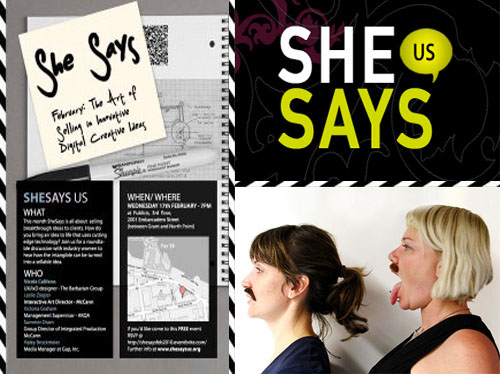
SheSays is one organization we give our unwavering support to. Originating in London, and now operating across the pond in the US, this .org serves as a global resource for women working in and around the field of advertising. The San Francisco division will be holding a round table discussion this evening, focusing on how to sell your ideas to clients when it comes to innovation and technology. One topic of particular interest will be augmented reality. If you’re in the San Francisco area, come participate in this FREE event and listen as business professionals give detailed experiences of what’s worked for them when combining business, branding and creativity. For more details and to RSVP, click here.

Speakers will include:

Nicole Califano, UX/IxD Designer from The Barbarian Group

Leslie Ziegler, Interactive Art Director from McCann Worldgroup

Victoria Graham, Management Supervisor at AKQA

Summer Oram, Group Director of Integrated Production at McCann Worldgroup

Haley Brockmeier, Media Manager at Gap, Inc.

Publicis San Francisco: 2001 Embarcadero, San Francisco, CA 94133

7:00pm – 9:00pm

Literary Intelligence: Information is Beautiful


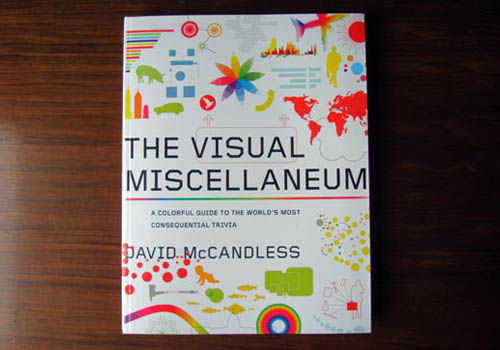
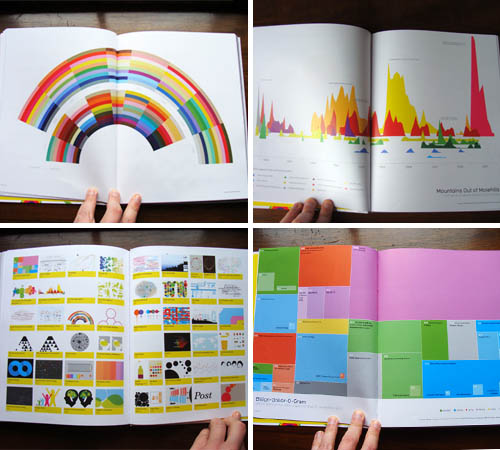
It’s quite a treat having friends that double as industry experts. Not only do I have reliable sources to bounce ideas off of, whenever a email recommendation ends up in my inbox, I know it’s from a trusted source. This morning, my good friend and colleague, Alexandra Machinist, a Manhattan based literary agent, sent a heads up about The Visual Miscellaneum: A Colorful Guide to the World’s Most Consequential Trivia, by David McCadless. McCadless’ new book is a collection of his most recent info graphics, knowledge maps and data visualizations. For any designer handed the task of simplifying data, then this is the book for you.

A few sneak peaks of what you’ll find in McCadless’ book. Enjoy and support!

New Face, New Year.


It feels good to be back. The past two weeks have been filled with round ups, predictions and general anxiousness for the decade ahead. While it’s easy to rev up for the big picture, it’s important not to forget the basic qualities of life that transcend all demographics.  Everyone has sentimental moments and it’s nice to see advertising and product teams shift their focus from gimmicky animation to simplistic messaging. Both American Express and Flor have chosen to step forward and focus on the emotive quality of everyday life. The above stills are part of a captivating TV spot that nearly stopped me in my tracks while running at the gym last week, a difficult feat for a non-TV watcher.

Partnering up with François Robert, Flor’s July release of rugs showcasing graphic imagery from his book, Find a Face are dauntingly similar to Am Ex’s Take Charge Campaign. While this concept certainly isn’t a new one, it’s interesting to see the cross pollination of an idea spread over a few month period.

Tracking Repetitive + Awesome.
On Instagram.