Pattern Pulp

Interview: Pattern Bakery


pattern-bakery

Patterns are on the rise in Helsinki, as four very talented women have recently joined forces to found the design studio, Pattern Bakery.  Beyond having a wonderful company name, Maria, Salla, Miia and Minttu all compliment each other quite strategically with a unified goal and varying creative backgrounds.  After first discovering this studio on Bloesem, we decided to throw a few questions their way to further understand their design process.  Check out our Q+A for a glimpse into the world of this pattern-minded printing studio.  We’re expecting big things from this creative quad.

*            *            *

PP:  The name “Pattern Bakery” is quite clever, how does each studio member’s specific talents, or “creative ingredients,” add to the mix?

PB: Our strength lies in the fact that we are all trained designers with varied backgrounds. For example, Minttu has previously worked as a fashion designer, Salla as a journalist, Miia has a keen interest in printed fabric and architecture and Maria in trend forecasting and the web.

Though we are all different personalities, we share a common interest and our drive helps us work together. It may be a cliché, but our differences complete each other and makes for a great mix of spices in terms of personality and visual style. This combination allows us to offer our customers a diverse selection of patterns.

PP: Please explain your studio’s design process, particularly when approaching new seasons and varying collections.

PB: Our kitchen always has something simmering! In addition to our research and on going curiosity for the future, one of our designers has a background in trend research and was recently a member of the Intercolor Finland team.  It’s only natural that every year we would create a recipe for the future.

Normally, everyone collects information that interests them. Once our research is complete, we bring our opinions to the table to discuss, then come to a consensus on how to visualize our hunch. Our designs become full themes with stories and color charts which we use as a backbone to our collection.

For example, right now we have seven different themes and color charts for our patterns. This ensures that a customer can match patterns from different designers and build their own collections from our body of work.

We pursue to illustrate the home and life in general.  All of our patterns have a story and reason behind them. The same applies to the other services we provide, such as custom-made collections, brand and design management and illustration.

PP: What are some of Pattern Bakery’s greatest challenges as a growing business?  Are there any business models that you look up and hope to emulate?

PB: Our biggest challenge is gaining our client’s awareness. We primarily sell our prints to companies without knowing where our patterns will end up.  This can make it difficult to explain why our designs will be beneficial to potential customers. Being located in Finland also creates it’s own geographical challenges, though the web is fairly global.

On a more personal level, it’s a challenge to maintain a balance between business and personal liberty. Any job has it’s good and bad days, but we really strive to keep our studio fun! It’s a wonderful thing to cook for ourselves rather than cut someone else’s cookies. Integrity is the key to our working philosophy. The business has to feel right.

PP:  How do you incorporate commercial trends into your collections and is this a factor that drives Pattern Bakery’s design?

PB: Design is a form of customer service. There are reasons why a certain client works with you, be it be style, recipe or taste. While a design might simply serve as decoration for some, it’s the core and soul for other customers. A pattern should convey a positive feeling, story and at the very least, relate to the product it’s being used for.

To achieve this, the each repeat should have a story behind it.  Commercial trends have roots and don’t appear out of the blue and the most interesting part of the process is translating trends into visual stories. As said before, it is not always conscious, but design is the pursuit of visualizing silent knowledge and trends into a concrete form.

A good pattern marries commercialism and something familiar that catches your eye. The most interesting designs aren’t always ready for market.

PP: Who are some of your dream clients?  If you could sell or license your patterns anywhere, where would they end up?

PB: Pattern Bakery is very much a pantry of ideas. The most optimal scenario would be to co-operate with a client in such a level that we get a grip on the core of the product. When you can influence the brand and not only the physical outcome, it’s a rewarding experience.

We would love to work on a campaign with a non-profit or develop the visual concept for a chain of an organic food-stores! We’re open for ideas.

Trend: Natural Formations


clinique-nantaka-plantation

Nearly everyone can remember their first trip to the Science Museum.  Between interactive displays and ecological wonders, it’s easy to understand why these educational centers have always drawn endless crowds.  Interestingly, many of the natural formations that have educated the masses are now being tapped for inspiration.  Rock patterns, as noted in late February, are continuing to subtly nudge their way into the the commercial marketplace, both figuratively and literally, adorning home accessory lines and commercial advertisements.  This Nature Exploration Agate greeting card, designed by Joy Deangdeelert Cho is one of many nature inspired prints on her website, Nantaka Joy.  In an effort to imply timeless beauty, Clinique ‘s latest product push embraces the tortoise, nature’s slow and steady (not to mention, reliable) winner.  Taking this theme to the most literal level, this rock-covered pillow from Plantation, in San Francisco, glamorizes the everyday pebble.

Flooring Solutions for Every Space


A few weeks ago, our dear friend Judy Prays requested pointed guidance on flooring solutions.  Having just left Brooklyn for LA, she had an endless to-do list, and getting her apartment in order was one check in need of web aggregation.  Scroll through our list of colorful solutions, as options range from custom to DIY.

Birds + Fish:

flooring-solutions-mammals

The Fish Rug by Eva Zeisal at The Rug Company, Bird Scallop Printed Rug at Urban Outfitters and the Flock Rug at CB2.

Florals:

flooring-solutions-florals

The Como Collection at Funky Rugs, Calvin Klein Floral Loom at Funky Rugs, and the Blosson Tree Rug at Urban Outfitters.

Earthy:

flooring-solutions-earthy

Forest Floor Rug at Angela Adams, Gold Leaves Rug at Spacify and Branches Rug at Spacify.

Puzzles:

flooring-solutions-puzzle

Puzzle Perser by Katrin Sonnleitner, Against the Grain at Flor and Puzzle by Puzzle Floor.

Floor Stencils:

flooring-solutions-stencils

Home Offices of De Leon & Primmer Architecture Workshop, JA45 Mokko stencil featured on Apartment Therapy and Catherine’s hand painted floor pattern featured on Design*Sponge.

Bold Geometrics:

flooring-solutions-bold-geometrics

Kashmir by Kyle Bunting , Lemon Ginger by Madeline Weinrub and The Xian Collection by Brink and Campman for Funky Rugs.

Sticker/Adhesives/Appliques:

flooring-solutions-stickers

Electrical Tapped Floor in NY Mag, Large Floor Sticker at Rockett St. George and Nenuphar stickers at Made in Design.

Graphic:

flooring-solutions-graphic

The Xian Collection by Brink and Campman for Funky Rugs, Crystals Rug at Angela Adams and Jorun Rug at Ikea.

Painterly:

flooring-solutions-painterly

Bois at Jamie Drake Rugs, Tibetan Modern Rug at Spacify, Blue Rink at The Rug Company.

Additional Contributions by Emily Gup.

Follow-up: Beetle Jewels


beetlejewels

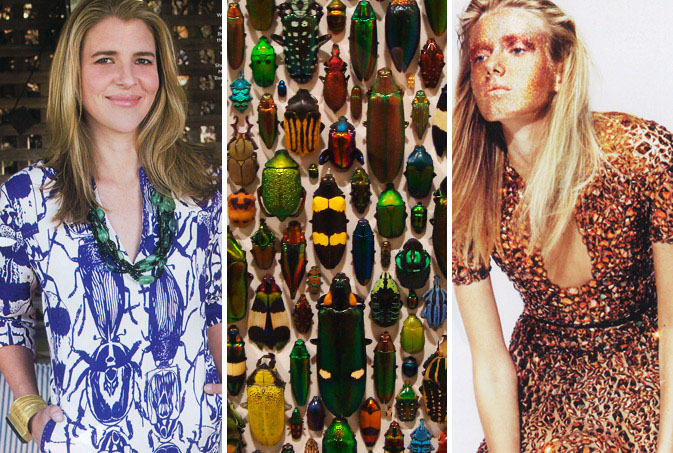
On a November trip to Paris, Pattern Pulp noticed a wash of insect repeats on everything from silk pillows to woven monograms.  Fast forward five months and it appears that this trend has traveled west, as we’re seeing beetle influences everywhere.  Samantha Gregory, the VP of Communications at Tory Burch successfully represents her company in this bold monochromatic repeat for her April feature in California Magazine.  Back on the east coast, Christopher Marley creates luxurious insect mosaics, showcasing his bizarre connoisseurship in the installation entitled, Pheremone at Barneys Madison Avenue location.  As usual, Dazed and Confused stylizes seed concepts at their best with this Alexander McQueen and Swarovski Spring/Summer 09 collaboration.

Interview: Beci Orpin


beci-orpin1

The creative work flowing from Beci Orpin’s Melbourne studio is incredible.  Just click on Orpin’s site and you’ll understand that her world of graphic design is more magical than most.  A menagerie of colorful mushrooms and fantasy-inspired silhouettes march across the screen with unabashed purpose, preparing the user for a unique mix of commercially friendly, widely applicable artwork.  While many are familiar with Orpin through her women’s clothing line, Princess Tina, she has recently closed the doors on this decade long endeavor in an effort to focus on other creative pursuits.  Check out our Q+A for a glimpse at Orpin’s creative process in addition to where you can find her creations in the coming season.

*            *            *

PP:  What websites do you generally start your day with-do you have a daily routine for news/blog/information consumption?

BO: I don’t usually have time to check blogs on a daily basis, I would says it is probably more of a weekly occurrence but when I do, the some ones I like are:

reference library
stork bites man
lena corwin
loobylu
meet me at mikes
fine little day
design sponge
the design files

PP: How did you discover your talent and how has it evolved over your career?

BO: I am not sure I discovered it – I had some sort of weird tunnel vision – there was nothing else.  Drawing and creating is all I ever wanted to do.  I remember 2 defining moments – one when i was 6 and drawing a picture of a wedding, and one when I was about 14 and drawing a cat. I cant remember exactly what happened, but while doing those 2 drawings something clicked and it confirmed that being creative was what I loved, and wanted to do with my life.

PP: Do you discuss your work with other designers?  If so, how does that impact your creation process?

BO: Most of my friends are in creative industries, so I guess as part of our general conversation we talk about work.  If I am stuck on something and need advice, I know I can always get honest and useful opinions from my partner/husband Raph and my assistant Leah. I think its a very valuable thing to get others opinions, especially when  you work for yourself – its easy to get trapped in your own world.

PP:  Where do you usually work on your patterns and what is your preferred method of creation + execution?

BO: I work with patterns in many forms, although a lot of my pattern work is for textiles.  I have also created patterns for wallpaper, murals, stationery and packaging.  As far as method,  it depends on what the pattern is for.  I don’t have a preferred method and will just do whatever is appropriate for the job. I am really liking hand-collaged paper mixed with computer lately.

PP:  When is the last time you took a professional/creative risk?

BO: Last November I decided to stop creating the women’s clothing line, Princess Tina.  After 8 years I had just had enough and felt it wasn’t relevant to my life anymore and decided to put all my energy into freelancing, my kids line (tiny mammoth), and a new line I am doing under my own name.  It was a risk because Princess Tina was still generating income for us and giving it up meant that income was no longer going to be there.  Though from the beginning, Raph and I decided that we don’t run our own business just to make money, we have to love all the projects we work on 100%.  I have never regretted leaving for one second and think by dedicating more time to other things, they will in turn replace some of the income Princess Tina brought in…. or maybe i will have to get real job instead!

PP:   Do you incorporate commercial trends into your work and if so, is this a factor that drives your design?

BO: I try not to follow trends as such, but I think it does happen sub-consciously sometimes. Obviously when you are following a brief from a client, sometimes you have to follow trends.  If I do, I at least try and interpret them in new ways.

Artist Profile: Aimée Wilder


aimee-wilder

Aimée Wilder is a pattern designer to watch.  Her prints can be found throughout the homegoods and fashion worlds, adorning pillows, walls, diaper bags and most recently, footwear.  Each of Wilder’s repeats are beautifully sophisticated with commercial appeal that raises the mass market ante.  Applying a refined color palette, Wilder veers away from sugary pastels that are category specific.  As a native New Yorker, Wilder spent her school holidays exploring fashion showrooms where both of her parents worked, soaking in trends and textiles, laying a foundation that would later influence her budding career.  Keep note of Wilder’s work, as we’re certain only good things will come from this Brooklyn wunderkind.

Additional contributions by Emily Gup.

Tracking Repetitive + Awesome.
On Instagram.