Pattern Pulp

Trend: Framing the Conversation


Frame art has gotten a lot of airtime over the past few years.  From global recognition in the fashion world (see Tokyo streets and London runway), to providing a polished edge in home decorating, the familiar gilded border is experiencing a welcome role reversal.

A recent New York Times discussion of the Met’s current exhibition, The Pictures Generation (1974-1984), recognizes that Allan McCollum’s installation, Collection of Forty Plaster Surrogates, heightens a viewer’s awareness simply by highlighting the unexpected.  “McCollum’s works were not presented as decorative accessories or social commentary but as physical signs of the mechanical drives of existence—of repetitious behaviour and patterns of market-based relationships.”

Drawing inspiration from this trend, Lisa Rengtsson, a young designer from Sweden, has created wallpaper designed to frame personal moments and details from everyday life.  Entitled, Familjen,this pattern provides the structure for artsy types to create their own visual diaries.

Furthering the concept of the visual diary, this examination wouldn’t be complete without the inclusion of Todd Selby, the extraordinary photographer and illustrator behind the website, The Selby.  On a weekly basis, Selby profiles interesting people within their own creative spaces.  This photo, for example, highlights Francois Curiel, the European Chairman at Christie’s Auction House.

Additional contributions by: Nicoletta Granati and Jennifer Machiavera

Interview: Dan Funderburgh


Dan Funderburgh

Every now and then you stumble upon work that is so creatively fascinating that it moves and inspires you.  Today we’re highlighting Dan Funderburgh, as his library of meticulous wallpaper falls into this awe-inspiring category.  Each of Funderburgh’s repeats draws upon historical references, be it Moorish mosaics, American op art, or simple tools humans use in everyday life.  Marrying commercial materials with modern day thought, Funderburgh’s art has seeped into several pockets of society, making significant waves throughout overlapping creative communities.  From 5Boro skateboards to the walls of Cooper-Hewitt’s Design Museum and the Miami’s Museum of Contemporary Art, Funderburgh continues to merge art, living and attitude.  Check out our Q+A for a glimpse into his daily routine.

*            *            *

PP: Do you have a daily routine for news/blog/information consumption?  What are your favorite publications?

DF: I start my day listening to public radio but usually glance over the NYTimes and BBC websites. As far as the bloggysphere there is far too much stuff to take in daily. I figure my friends will send me something if it’s really important. I do like my friend Kelly’s blog, Nothing is New.

And of course Arkitip and 12oz. where kindred spirits Cody Hudson, Grotesk, Ryan Geezer, and The Chinatown Soccer Club post.

PP: How did you discover your talent and how has it evolved over your career?

DF: I don’t know so much about a talent, but I discovered I have an acute appreciation for intricate ornamental arts about the same time that I discovered I have a limited patience for non creative corporate logo re-sizing. So I quit my job and tried to make my way as a wallpaper maker and artist.

PP:  Do you discuss your work with other designers?  If so, how does that impact your creation process?

DF:  All the time! Not too many other wallpaper designers, but I’m surrounded by smart artists and designers and photographers that help me tremendously. Not so much on the minutia of a specific piece, but more for larger questions about direction and concept.

PP: Where do you usually work on your patterns and what is your preferred method of creation + execution?

DF: Usually rough sketches in pencil and then redrawn from scratch in the computer. I try to always be open to other options –> painting and photography in case the idea calls for it.

PP:  When is the last time you took a professional/creative risk?

DF: Too long ago. It’s probably time I should take some more.

PP:  Do you incorporate commercial trends into your work and if so, is this a factor that drives your design?

DF: Of course not ! That was a trick question. I suppose a few years perspective will be the judge of whether I’m apart from the flock or just fooling myself.

Artist Profile: Aimée Wilder


aimee-wilder

Aimée Wilder is a pattern designer to watch.  Her prints can be found throughout the homegoods and fashion worlds, adorning pillows, walls, diaper bags and most recently, footwear.  Each of Wilder’s repeats are beautifully sophisticated with commercial appeal that raises the mass market ante.  Applying a refined color palette, Wilder veers away from sugary pastels that are category specific.  As a native New Yorker, Wilder spent her school holidays exploring fashion showrooms where both of her parents worked, soaking in trends and textiles, laying a foundation that would later influence her budding career.  Keep note of Wilder’s work, as we’re certain only good things will come from this Brooklyn wunderkind.

Additional contributions by Emily Gup.

Trend: Linear Jumbles


barneys-southbeach

Over the weekend, I had the good fortune of escaping the cold wet city for Miami.  In between bouts of beach and people watching, I popped into the shops along Collins Ave to see if South Beach had more to offer than bedazzled Ed Hardy paraphernalia.  As predicted, Barney’s quenched my thirst for innovation.  I was astonished by the simple lighting solution that brightened the entire menswear floor.  “People will come from all over to visit the store, so we definitely wanted elements of memorability and surprise,” said Kent Wells, Director of Retail Planning and Design for RGLA .  Relying on new and creative ways to use utilitarian objects, Barney’s Miami CO-OP combined a mix of materials, fixturing systems and artisan objects to create an eclectic store environment, with an emphasis on wacky and fun.

dahlback-sunshineandshadow-jasperjohns

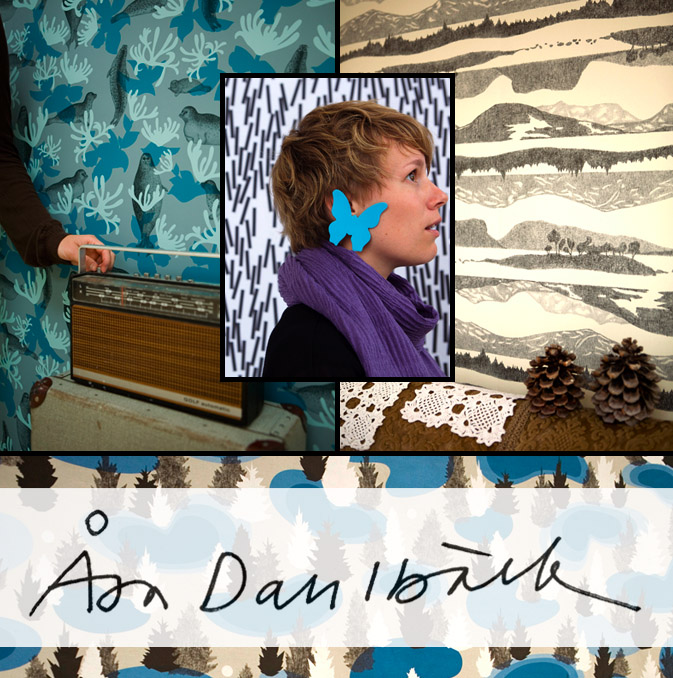
Speaking of wacky and fun, linear jumbles can be found across creative platforms in the homegoods, fashion and art worlds.  Åsa Dahlbäck, a Pattern Pulp favorite and recent interviewee, designed this vertically frenzied wallpaper from her studio in Sweden.  Each moving cluster is reminiscent of the motercycle traffic I experienced while traveling throughout South East Asia a few years ago- a snapshot of moving chaos. Lily Raskind, the founder and lead creative of Sunshine & Shadow, showcases boldly understated pieces in her Spring/Summer ’09 collection by combining feminine and masculine details.  At a quick glance, Raskind’s textiles look like an abstract version of pick-up-sticks.  Using color and line to create a maze of texture, Jasper Johns adds historical relevance to this trend in his untitled Lithograph from 1972, a work that’s currently on display at the MoMA.

Interview: Åsa Dahlbäck


asa-dahlback1

Åsa Dahlbäck is as calculated as she is original, particularly when it comes to pattern making.  Born and trained in Sweden,  Dahlbäck brings her design expertise and knack for reinterpretation to Lula, a multi-disciplinary art and design studio based in Gothenburg, Sweden. Her patterns are often nature-inspired and possess a graphic flair that incorporates relevant iconography.  “The patterns are built from what I find characteristic for the different (local) provinces,” a consistent theme throughout much of Dahlbäck’s portfolio.  Check out our Q+A for a glimpse into her daily design routine.

*            *            *

PP:  What websites do you generally start your day with-do you have a daily routine for news/blog/information consumption?

AD: I start my morning by reading a Swedish newspaper site and when I need a break and something beautiful to look at I usually visit my friend Elisabeth’s blog. Her photographs make my day sunny.

PP:  How did you discover your talent and how has it evolved over your career?

AD: Talent is something very abstract. For me it has been about allowing myself to do what feels natural for me.  This is still the case and probably what drives me forward.

PP:  Do you discuss your work with other designers?  If so, how does that impact your creation process?

AD: When I’m into something I can be a bit introvert. This is something I try to change, because I want to share my process and I know the result is always improving when I invite others.

PP:  Where do you usually work on your patterns and what is your preferred method of creation + execution?

AD: In the sketching process I try to have a variety of different methods going on at the same time. Pen and paper, using scissors to do cutouts, computer drawing and photographic collages. I mostly work with a chosen theme where I combine stories with different forms of sketching.

PP:  When is the last time you took a professional/creative risk?

AD: When I feel I’m taking a risk I know it means I’m doing something different from the last time. I try to welcome and stay safe in this feeling, because it usually leads me in a new direction.

PP:   Do you incorporate commercial trends into your work and if so, is this a factor that drives your design?

AD: I can’t say it drives my design, but it usually affects me in one way or the other. Trends usually say something about the time we live in and my curiosity for what’s going on around me is probably colouring my work.

Interview: Deborah Bowness


deb-bowness

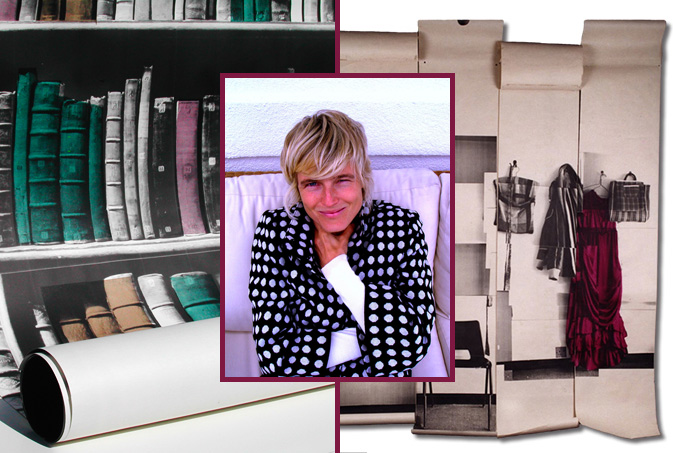
Our fascination with Deborah Bowness has only grown since last month’s faux library post.  Trained in Leeds, and later in London at The Royal College of Art, Bowness has been designing and hand-printing wallpaper for over 8 years. Her unique style of trompe l’oel has donned trendy locals such as the New York Soho House and Phillip Stark’s Yoo-Aldelgade in Copenhagen. Combining an artistically forward eye with experimental styles and luxurious materials, Bowness breaks traditional barriers, creating functional works of art that are a true breath of fresh air.  Reinterpreting the world with a photographic lens and 2D palette, her collections are as playful as they are sophisticated. Check out our Q+A for a glimpse into her daily routine.

*            *            *

PP: What websites do you generally start your day with-do you have a daily routine for news/blog/information consumption?

DB: I do not surf regularly.  I prefer books magazines and newspapers.

PP: How did you discover your talent and how has it evolved over your career?

DB: I focused on my creativity during my studies 3 years in Leeds, followed by a masters at the RCA London.  There is nothing like DOing it everyday to discover what you’re about.

PP: Do you discuss your work with other designers?  If so, how does that impact your creation process?

DB: I discuss my work with those (who) put it in its space or place.  The work becomes more real as it has it’s purpose.

PP:  Where do you usually work on your patterns and what is your preferred method of creation + execution?

DB: I have been working from home for the past year mainly with collage in sketch books.

PP:  When is the last time you took a professional/creative risk?

DB: I am currently taking a professional risk which I can not tell you about until its done.  I always try to take  creative ones- its not creative if it’s not a risk!

PP: Do you incorporate commercial trends into your work and if so, is this a factor that drives your design?

DB: I try to follow my own path.  I don’t find it healthy for my work to be involved with trends or the commercial (aspect).  Trends are ephemeral.

Tracking Repetitive + Awesome.
On Instagram.