Pattern Pulp

Tuesday's Gallery Picks


gallerypicks_patternpulp138

Our artists contemplate the ability of the world to transform in this week’s gallery picks.

*            *            *

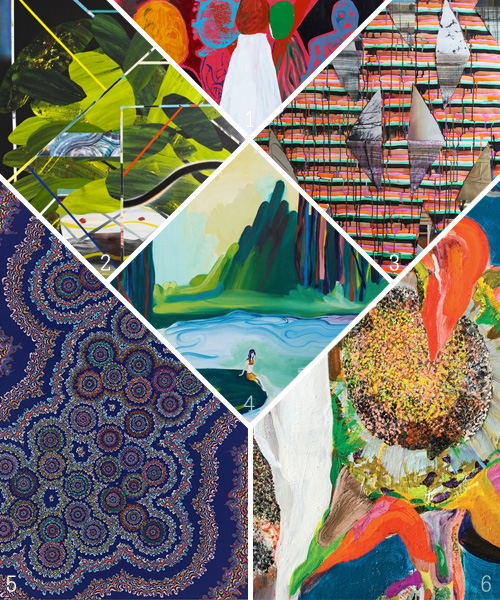
1. “The Colossalalia paintings are a rogues’ gallery of old Los Angeles neighborhoods. They serve as visual signposts to a landscape vaguely recalled, or no longer extant. As neighborhoods change through neglect, destruction or development, these paintings remain as souvenirs of a world systematically being erased” – Hilary Baker at Offramp Gallery
2. Mark Ryden’s latest series is informed by the geometric structure “dodecahedron,” a solid figure bearing 12 sides whose perfect symmetry has been the source of extensive query by mathematicians and scientists since antiquity. Drawing upon the form’s mystery and divine connotations as a source of inspiration, Ryden explores the bridge between the physical world and the intangible realm at Paul Kasmin Gallery
3. The vocabulary of images in Mark Ryden’s new body of work remains consistent with his pervasive distortion of scale and his iconic fairytale-like creatures set against seductive landscapes of untouched beauty. However, the subject of his latest series is informed by the geometric structure “dodecahedron,” a solid figure bearing twelve sides whose perfect symmetry has been the source of extensive query by mathematicians and scientists since antiquity Ron English’s Neonature examines the art of evolution, the flaw that propels civilization at Corey Helford Gallery
4. Examining the evolution of the feather at Andrea Rosen Gallery
5. Both David Marc Grant and Adrian Landon Brooks are influenced by the notion of time – past, present and future. Grant continues to explore the idea of a mythical future world in his series of acrylic paintings on wood panel. In contrast, Brooks is inspired by materials and aesthetics of past eras at Campfire Gallery
6. Whitney Bedford’s exhibition will include a series of uniformly scaled landscapes; these images of a tropical desert form an exploration of the sublime, of Eden, of the origins of awe in nature, that hints at the cinematic. Bedford will also present a trio of monumental landscape paintings rendered in gold ink with her exemplary draftsmanship and painterly exuberance at Susanne Vielmetter Los Angeles Projects

Tuesday's Gallery Picks


gallerypicks_patternpulp137

This week’s gallery picks examine intersections of reality, space and influences.

*            *            *

1. This idiosyncratic selection looks at the diverse ways in which notions of inner and outer space are perceived and utilized as a topic within artistic practice at Edward Thorp Gallery
2. Ilya & Emilia Kabakov’s new collaborative series The Two Times explores layered or dual realities, a prominent theme within the Kabakov’s work. Representations of a distant, classical past are spliced with images of fragmented memories from the Soviet era, conveying the collision of two time periods. The multi-layered interpretations emphasize human perceptions of time and the temporal nature of the present, which is constantly emerging from and turning into the past at Pace Gallery
3. A winter group show with an otherworldly vibe at Joseph Gross Gallery
4. Matt Wedel’s Peaceable Fruit comes out of a larger interest in landscape within his work and is a kind of hopeful signifier and idealized blueprint in understanding the future of humanity at La Louver
5. In his ongoing investigation of his intimate environment, Jonas Wood fuses artistic influences as diverse as the domestic interiors of Pierre Bonnard, Henri Matisse, and David Hockney to Chinese and Japanese still-life scenes, ancient pottery and the guileless textiles of Josef Frank. Sampling subjects from his own photographs, he reiterates them through an intensive process of drawing. Filling the compressed spaces of his paintings with figures, plants, and household objects, Wood reimagines the world as a variegated collage of overlapping patterns, flatly rendered at Gagosian London
6. Erik Parker’s Undertow offers insight into the evolution of Parker’s work over the last two decades. Parker continues to critically chart the world’s current political, social, and economic landscapes with compositions brimming with references to media, popular culture, music, and art history. Synthesizing multiple elements from his myriad styles into new dynamic compositions, the artist works at breaking down the metanarratives of late modernist painting while simultaneously digesting the pictorial chatter of scrolling feeds of social media at Paul Kasmin Gallery


Tuesday's Gallery Picks


gallerypicks_patternpulp136

This week’s artists hone and reinterpret techniques in order to explore the landscapes around them.

*            *            *

1. Simon Hantaï: Blancs highlights the artist’s groundbreaking series of multi-colored paintings from 1973-1974. His signature method of the pliage technique involved folding the unstretched canvas, painting the exterior and then unfolding the canvas, resulted in a composition imbued with both painterly control and serendipity at Paul Kasmin Gallery
2. Laura McPhee’s The Home and the World: A View of Calcutta presents images that are less an overview of this city of 15 million than a glimps into its complex, often conflicted soul. The photographs gauge both the history of personal spaces and impart a sense of intimacy and calm that often belies the maelstrom that can be found in the external world at Benrubi Gallery
3. Teresita Fernández’s newest body of work continues her exploration and interest in scale as an elastic concept, and the correlation between the immense and the intimate; the vast and the miniature; the macro and the micro. Shrinking the viewpoint in order to amplify what we see, Fernández worked with malachite mineral rocks, using imaging techniques to look at their interiors. What initiated Fernández’s interest in exploring the inside of these heavy, earth-bound materials was their uncanny likeness to the actual full-sized landscape of the Viñales Valley, an iconic and surreal landscape in rural Cuba at Lehmann Maupin
4. Ryan Mrozowski’s Open, Other, End duplicates, repeats, and inverts the most commonplace of imagery (oranges, polka dots, birds, flowers, grass) in endless variations. These items, broken into their constituent parts and stripped of specific or personal context, reveal the uncanny and absurd appearance of a world subject to excessive cataloguing and archivingat On Stellar Rays
5. In this new and intertwined bodies of work on view, Meghann Riepenhoff continues to explore themes of landscape, time, and impermanence and subjects of rain, ocean, and shoreline at SF Camerawork
6. Ryan McGinley’s Winter photographs portray his nude figures in frozen landscapes at Team (gallery, inc.)


Tuesday's Gallery Picks


gallerypicks_patternpulp130

This week’s artists experiment with materials + medium to explore and express their message.

*            *            *

1. Crystal Wagner’s work in Biotica combines 2D and 3D forms while investigating alternative uses of materials through hybrid approaches to printmaking, sculpture, and installation. Her work consists of smaller shadowbox-like sculptures and large scale paper installation that fill the gallery space at 108 Contemporary
2. Jane Rosen’s new exhibition of stone, glass, and bronze works, Cash-Morandi, is a play of presences—a balance between nature and culture, or what Rosen calls “landscape time and domestic time.” In her works, birds of prey and vessels formed of opaque glass perch on hewn stone piers, their surfaces and edges as worn as beach glass at Sears-Peyton Gallery
3. While utilizing the plethora of techniques and materials, Ruth Hardinger and Kara Rooney choose to express their ideas through the exploration of three dimensional, or sculptural idioms, with drawing, photography, digital collage or stone wool being an integral part of the work. There is an open ended dialogue of technologies and materials enacted, of past and present experience; there are traces of the multiple processes and substances used to create individual pieces at Five Myles
4. These new Ingres-inspired paintings are an evolution of Taner Ceylan’s Unfinished Painting series, which also examine historical Orientalist portraits through a contemporary, Eastern lens. The portraits involved an in-depth study of Ingres’ technique and process, as well as a detailed, in-person analysis of the original painting at The Metropolitan Museum of Art, New York at Paul Kasmin Gallery
5. Jared Madere primarily creates installation-based works featuring disparate materials such as salt, flowers, foodstuffs, and plastic tarps that are assembled and aggregated in a manner that insists on their material connections to society, economics, industry, and human emotion. For Madere, the meanings and associations of objects are never stripped away— floral arrangements can point to longing or sadness and a burnt coat is imbued with isolation and dejection at Whitney Museum of American Art
6. Kim Simonsson uses traditional techniques to create sensitive and surreal painted ceramic sculptures. His sculptures combine innocent animal and child forms with a twist of violence and suspense to create a monumental physical presence at Jason Jacques Inc.

Tuesday's Gallery Picks


gallerypicks_patternpulp114

Our artists are crafting stories and expanding upon themes in this week’s gallery picks.

*            *            *

1. Trenton Doyle Hancock’s I Want To Be at the Meeting After the Separation will feature a number of new paintings, part of Hancock’s ongoing grand saga portraying the birth, death, afterlife and dream-like states of a range of characters, particularly the Mounds (half-animal, half-plant like creatures) and their aggressors, the Vegans at Hales Gallery
2. In his latest body of work, Paul Wackers continues to play with notions of the familiar, creating dynamic and increasingly complex visual environments replete with recognizable yet ultimately unknowable objects. In these paintings of shelves, windows, and interior landscapes, forms range from non-representational layers of viscous paint to discernible objects at Morgan Lehman Gallery
3. Alexandra Grant and Steve Roden: “These Carnations Defy Language” began as a “seed”—a conversation between the artists in regards to Mute Objects of Expression, an anthology of the French poet Francis Ponge at Pasadena Museum of California Art
4. Edith Beaucage’s Chill Bivouac Rhymes invites you to follow a small group of teens at a rave concert. In parallel to Roland Barthes search for openness of interpretation in literature; Beaucage organized her current exhibition to allow for a looseleaf narrative at CB1 Gallery
5. Kelsey Brookes: Plants Of The Gods features new monumental paintings based on Brookes’ scientific investigations into nature’s ancient botanical compounds at Eric Firestone Gallery
6. Santi Moix’s works have long been characterized by their accumulation of saturated biomorphic forms that are simultaneously figurative, narrative and abstract. Here, Moix returns to the central themes in his oeuvre, evoking plant and animal life by sifting through the breadth of studies and trial works on paper then collaging them onto large canvas backdrops at Paul Kasmin Gallery

Tuesday's Gallery Picks


gallerypicks_patternpulp77

This week’s artists explore the art of movement in its many forms.

*            *            *

1. Exploring the splendor of the female form in dance, REKA’s deft brushstrokes and fluid lines create a hypnotic dynamic movement that prances between his canvases at Stolen Space
2. Daniel Sturgis’ dizzying explorations of shape and form at Art First
3. Kelsey Brookes explores the science of sleep via Library Street Collective
4. Exploring the ideas of Goethe’s Colour Theory, though both painting and a botanical installation at Rook & Raven Gallery
5. James Nares’ High Speed Drawings demonstrates his masterful ability to capture precise moments in time and extend them through visual representation at Paul Kasmin Gallery
6. Space Age riffs on Lucio Fontana’s description of Spatialism (Spazialismo), which called for artists to expand their work into the third dimension, and away from the illusory space of traditional easel painting at Hus Gallery

Tracking Repetitive + Awesome.
On Instagram.