Pattern Pulp

Fashion: Zip and Repeat


zippers2

Zippers, the commonplace closure, have been striped of their hidden functionality and thrust into the spotlight, proving they can double as innovative solutions as well as decorative patterns.  The results are striking, and slightly quirky.  Part of the zipper’s appeal, perhaps, when compared to its closure counterparts such as buttons, hooks, and snaps, is the fluidity of movement.  This is evident in Ji Woong’s Zip Up Tangles, a creative solution to the wiry mess we all experience when reaching for our ear buds.  Stepping it up a few notches, Van Cleef & Arpels has recently dove into it’s archival library to revive it’s 1950’s Zip Necklace.  While today’s version may be toned down, it’s no less elegant, and a primary example of how innovation can have timeless appeal.

zippers

In a French design studio not far from Van Cleep & Arpels’ headquarters, Julien Rivoire, an Art Director and Graphic Designer, has applied his own zipper technique to Sixpack’s infamous t-shirt collection. Revealing striped down beauty in the most simplistic of logos, the Z and the P are solidified by the I in this seamless application of the object’s functionality.  Continuing with the theme of black and white, this patterned skirt playfully mimics the sex appeal zippers posess when applied to women’s clothing.

Zoe Cotlenko, a French jewelry designer and zipper connoisseur, is the mastermind behind this line of candy-colored necklaces and bracelets.  Using his illustration skills, Eric Elm’s zipper and button bag made its debut at Colette a year ago this month.  Elm’s work has been equally influential in New York, as proven by this remarkable 3D installation at the Nike 255 space in NYC for the Make Something Project, which was held in collaboration with Aaron Rose & Beautiful Losers Show.

Additional Contributions by Emily Gup.

Trend: Pixel Mashing


burton-bloomingdales

Photography and graphic design have become so interconnected in today’s marketplace that one medium rarely exists without the other.  Websites like ffffound and qbn showcase the best and the brightest, overshadowing what many print monthlies used to accomplish.  By offering a 24/7 stream of creative inspiration, designers and critics alike have been able to familiarize themselves with what’s current.  This photo, taken by Bueller Designs in LA, displays a cluster of translucent dots that are a result water and light.  By merely adding saturation and a grid, brands like Burton and Bloomingdales prove that the transition from natural beauty to commercial glam can be a quick (and profitable) one.

Print: Environmental Prisms


prism-pop

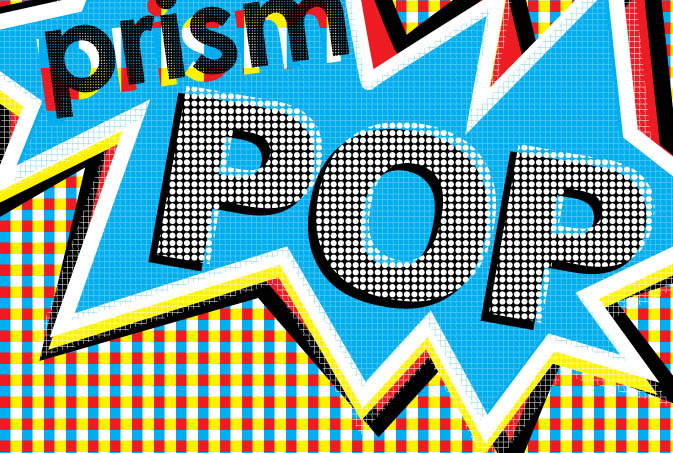
Just as chefs have an intimate relationship with their food, graphic designers are often tied to their pixels.  Much of the time these creative atoms are invisible at final execution, however lately, as our collective romance with the digital world has grown, so has the size of these geometric marks.  Lisa Toff, the blogger behind MyConey, exemplifies this design style with her recently founded card company, prismPOP.  Using bright vectors and soy inks to communicate her illustrations, Toff proves that you can be environmentally conscious while making a bold creative statement.

Toff will be showcasing her latest collection in Brooklyn this Sunday at the Handmade Cavalcade in addition to the Renegade Craft Fair in early June.  For 20% off your next order (on etsy or in person), sign up for the mailing list and reference Pattern Pulp  – you’ll receive a coupon via e-mail.

Interview: Beci Orpin


beci-orpin1

The creative work flowing from Beci Orpin’s Melbourne studio is incredible.  Just click on Orpin’s site and you’ll understand that her world of graphic design is more magical than most.  A menagerie of colorful mushrooms and fantasy-inspired silhouettes march across the screen with unabashed purpose, preparing the user for a unique mix of commercially friendly, widely applicable artwork.  While many are familiar with Orpin through her women’s clothing line, Princess Tina, she has recently closed the doors on this decade long endeavor in an effort to focus on other creative pursuits.  Check out our Q+A for a glimpse at Orpin’s creative process in addition to where you can find her creations in the coming season.

*            *            *

PP:  What websites do you generally start your day with-do you have a daily routine for news/blog/information consumption?

BO: I don’t usually have time to check blogs on a daily basis, I would says it is probably more of a weekly occurrence but when I do, the some ones I like are:

reference library
stork bites man
lena corwin
loobylu
meet me at mikes
fine little day
design sponge
the design files

PP: How did you discover your talent and how has it evolved over your career?

BO: I am not sure I discovered it – I had some sort of weird tunnel vision – there was nothing else.  Drawing and creating is all I ever wanted to do.  I remember 2 defining moments – one when i was 6 and drawing a picture of a wedding, and one when I was about 14 and drawing a cat. I cant remember exactly what happened, but while doing those 2 drawings something clicked and it confirmed that being creative was what I loved, and wanted to do with my life.

PP: Do you discuss your work with other designers?  If so, how does that impact your creation process?

BO: Most of my friends are in creative industries, so I guess as part of our general conversation we talk about work.  If I am stuck on something and need advice, I know I can always get honest and useful opinions from my partner/husband Raph and my assistant Leah. I think its a very valuable thing to get others opinions, especially when  you work for yourself – its easy to get trapped in your own world.

PP:  Where do you usually work on your patterns and what is your preferred method of creation + execution?

BO: I work with patterns in many forms, although a lot of my pattern work is for textiles.  I have also created patterns for wallpaper, murals, stationery and packaging.  As far as method,  it depends on what the pattern is for.  I don’t have a preferred method and will just do whatever is appropriate for the job. I am really liking hand-collaged paper mixed with computer lately.

PP:  When is the last time you took a professional/creative risk?

BO: Last November I decided to stop creating the women’s clothing line, Princess Tina.  After 8 years I had just had enough and felt it wasn’t relevant to my life anymore and decided to put all my energy into freelancing, my kids line (tiny mammoth), and a new line I am doing under my own name.  It was a risk because Princess Tina was still generating income for us and giving it up meant that income was no longer going to be there.  Though from the beginning, Raph and I decided that we don’t run our own business just to make money, we have to love all the projects we work on 100%.  I have never regretted leaving for one second and think by dedicating more time to other things, they will in turn replace some of the income Princess Tina brought in…. or maybe i will have to get real job instead!

PP:   Do you incorporate commercial trends into your work and if so, is this a factor that drives your design?

BO: I try not to follow trends as such, but I think it does happen sub-consciously sometimes. Obviously when you are following a brief from a client, sometimes you have to follow trends.  If I do, I at least try and interpret them in new ways.

Interview: Åsa Dahlbäck


asa-dahlback1

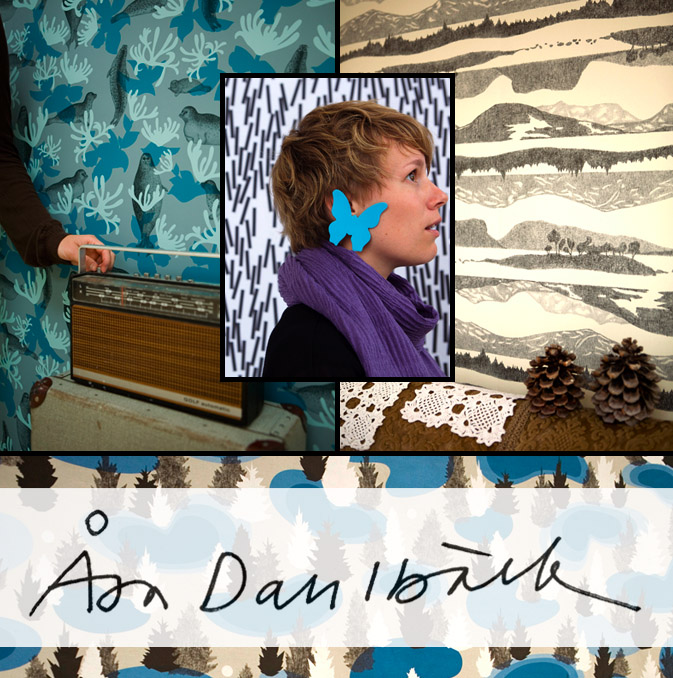
Åsa Dahlbäck is as calculated as she is original, particularly when it comes to pattern making.  Born and trained in Sweden,  Dahlbäck brings her design expertise and knack for reinterpretation to Lula, a multi-disciplinary art and design studio based in Gothenburg, Sweden. Her patterns are often nature-inspired and possess a graphic flair that incorporates relevant iconography.  “The patterns are built from what I find characteristic for the different (local) provinces,” a consistent theme throughout much of Dahlbäck’s portfolio.  Check out our Q+A for a glimpse into her daily design routine.

*            *            *

PP:  What websites do you generally start your day with-do you have a daily routine for news/blog/information consumption?

AD: I start my morning by reading a Swedish newspaper site and when I need a break and something beautiful to look at I usually visit my friend Elisabeth’s blog. Her photographs make my day sunny.

PP:  How did you discover your talent and how has it evolved over your career?

AD: Talent is something very abstract. For me it has been about allowing myself to do what feels natural for me.  This is still the case and probably what drives me forward.

PP:  Do you discuss your work with other designers?  If so, how does that impact your creation process?

AD: When I’m into something I can be a bit introvert. This is something I try to change, because I want to share my process and I know the result is always improving when I invite others.

PP:  Where do you usually work on your patterns and what is your preferred method of creation + execution?

AD: In the sketching process I try to have a variety of different methods going on at the same time. Pen and paper, using scissors to do cutouts, computer drawing and photographic collages. I mostly work with a chosen theme where I combine stories with different forms of sketching.

PP:  When is the last time you took a professional/creative risk?

AD: When I feel I’m taking a risk I know it means I’m doing something different from the last time. I try to welcome and stay safe in this feeling, because it usually leads me in a new direction.

PP:   Do you incorporate commercial trends into your work and if so, is this a factor that drives your design?

AD: I can’t say it drives my design, but it usually affects me in one way or the other. Trends usually say something about the time we live in and my curiosity for what’s going on around me is probably colouring my work.

Interview: Amy Soczka


amy-soczka-patterns

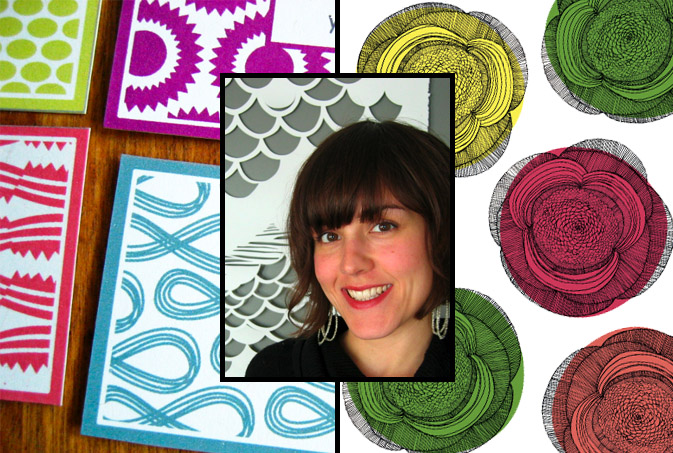
It’s always a pleasure to jump beyond the coastal design scene to inspect what’s going on in the midwest.  While casually scrolling through design*sponge’s highlights a few months back, I nearly flipped when I stumbled upon Amy Soczka’s paper cut out displays for Urban Outfitters.  Paper has become a popular retail material as of late, as it’s affordability and versatility is incomparable. Soczka’s creations tap this trend while setting new creative standards. Her intricate handwork and artistic eye crosses multiple mediums and platforms, ranging from printed greeting cards and homegoods to commercial collaborative ventures.  Check out our Q+A for a glimpse into Amy’s daily routine.

*            *            *

PP:  What websites do you generally start your day with- do you have a daily routine for news/blog/information consumption?

AS: A few of my favorites right now are:

designspongeonline
sfgirlbybay
ffffound
jeanasohn
dearada
lenacorwin
fecalface
nytimes
kalman.blogs.nytimes

I also check in at Flickr and Facebook to see what my friends and contacts are up to. I tend to poke around online while I am enjoying my coffee and planning my day – all of the design blogs provide good eye candy and motivation to work harder.

PP: Do you discuss your work with other designers?  If so, how does that impact your creation process?

AS: One thing I miss about art school is the opportunity to discuss work with a variety of people at any time. Working in my home studio, I don’t often get the chance to interact with other designers. When I am having a hard time with something, I will seek feedback from friends who are artists or designers. Ultimately what I need is a new perspective – second-guessing myself is a common challenge and it’s good to have people who can give encouragement or criticism to help the process along.

PP:  Where do you usually work on your patterns and what is your preferred method of creation + execution?

AS: I have a studio in my home and that’s where I spend most of my time. It’s getting pretty crowded in there though, so when possible I’ll take my laptop to a different area of the house and camp out. My method is consistently a mix of computer and handmade technique, but I would definitely say that every design and idea starts with a drawing in my sketchbook.

PP:  How did you discover your talent and how has it evolved over your career?

AS: Some of my earliest memories have to do with drawing: drawing contests with my sister, having access to piles of fresh white paper all the time because my grandfater worked at a paper mill, being allowed to color on the wallpaper that covered the kitchen walls because it would be torn down the next week. I was always in art clubs and after school drawing classes – my mom has been a constant source of encouragement and gave me a lot of opportunities to explore.

I think the evolution of my work over the last 5 years has been about finding a way to do what I want to do and make a living doing it. I have been stubborn and sort of wiggled my way into the place I am now and the challenge is how to keep it moving forward so that I can call this a career.

PP:  Do you incorporate commercial trends into your work and if so, is this a factor that drives your design?

AS: It would be nearly impossible for me to be a part of the design community without having a certain amount of consideration for trends and what’s hot. I never approach new work thinking about that, but I do think about how I can apply my ideas in innovative ways and how people react to one design more than another.

PP:   Do you have any advice for younger designers just getting started?

AS: I think it’s really important to have a well-rounded background. Drawing, printmaking, photography, and graphic design are all closely related and to know something about each of them is going to make your process stronger. Avoid oversaturating yourself with design – I love looking at the work of my peers, but sometimes I have to take a break from it to clear up my vision. Seek out opportunities to learn from people who are where you want to be, whether that is an internship or a conversation – people who are proud of their work generally want to share that with others. You won’t get very far sitting still, so ask questions and get involved. Lastly, a good friend of mine told me the key to success -“work on your work.”

Tracking Repetitive + Awesome.
On Instagram.