Pattern Pulp

Street Finds: Geometric Graffiti Mash-Ups


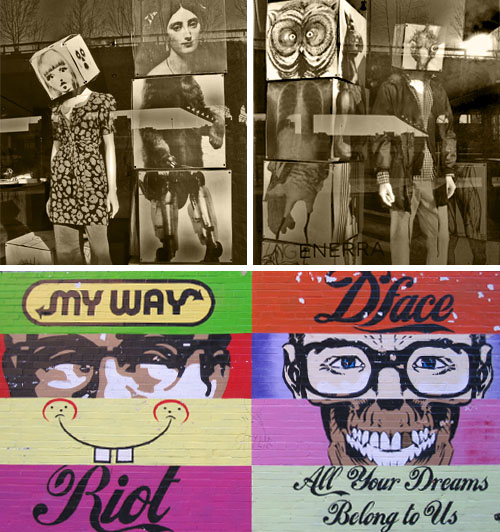
I spent some time walking round the meat packing district today while waiting for my laptop to be maintenanced at the 14th St. Apple Store. Though I’ve seen D*Face‘s mural close to a thousand times, it’s relevancy was elevated after noticing Generra‘s storefront. Black and white blocks stacked together comprised of Flora and Fauna were a complete parallel to D*Face’s baseline concept.  Both compositions are beautifully designed, interesting to dissect and provide social and political commentary of our current global climate. Whichever brand of culture you choose to identify with- be it historical, branded or generic, these geometric “quilts” are a thoughtful reflection of current creative styles, not to mention an interesting window into a now popularized counter-culture.

The Herringbone Collective


Herringbone is about as popular as plaid. That being said, the variations in execution keep it fresh from season to season. Designers are continually reinventing the wheel, breathing life into this timeless classic. Ari Heckman, a development consultant and interior designer based in New York City, uses a wide array of materials, such as carrera marble, glass and metal when tiling this pattern for various clients. “I enjoy using textured patterns that reference men’s suiting for interior settings.  There’s something about the translation from fabric to a more durable material, like marble or stone, that’s very exciting to me.” The examples above showcase glass work from Noho Star, a restaurant in New York, a piece of graffiti on 23rd Street in Chelsea, Nero Marquina marble, a leather woven Cole Haan handbag, colorful woodwork in the children’s department at Printemps in Paris and a yarn stitched pillow that’s currently on sale at Urban Outfitters.

Creative City Tour: DUMBO


DUMBO_pattern-tour1

I’m very pleased to announce the start of a new series we’re launching:  The Pattern Pulp Global Tour.

In today’s digital travel age, we’re all familiar with the endless to-do tips found on sites like the New York Times, Trip Advisor and Gridskipper.  While more traditional recommendations are always welcome, the notion of self-discovery should not be forgotten. With each neighborhood exploration, we hope to take our readers off the beaten path to uncover the overlooked elements of city living, be it decals on an office building or graffiti in a bathroom stall.  Some of what we feature may be gone by the time you arrive, others, such as buildings and landmarks will certainly find their place along the chain, but either way, our goal is to provide the groundwork for a visual stream of consciousness.

Today, we’re featuring Dumbo, a creative and industrial gem that is located just over (and under) the Brooklyn Bridge. Have a look, take the walking tour and let us know what you think!

*            *            *

1. Hallway: 147 Front St.

2. Workshop Loves You, glass decals: 147 Front St.

3. Dumbo Arts Center, 30 Washington St.

4. Exterior building details, Water St. at Old Dock St.

5. Cafe Baco pattern napkins: 71 Jay St.

6. Cafe Baco metal signage: 71 Jay St.

7. Graffiti portraiture on cement steps: 70 Jay St.

8. Brooklyn Bridge Flea Market, metal tiles: 22 Water St.

9. St. Ann’s Warehouse, Playhouse: 38 Water St.

10. Pastel floral door, 128 Front St.

11. Brooklyn Bridge

12. Womens bathroom graffiti: 147 Front St.

The full set of photos can be viewed here.

1-dumbo-frontstreet 2-dumbo-workshop 3-dumbo-artscenter 4-dumbo-warehouse 5-dumbo-bacocafe1 6-dumbo-bacocafe2 7-dumbo-jayst-graffiti 8-dumbo-fleamarket 9-dumbo-stanns-warehouse 10-dumbo-frontstreet 11-dumbo-brooklyn-bridge 12-dumbo-front-street-bathroom 13-dumbo-68Jay

Street Finds: Urban Palettes


city-grunge1

For all of the reasons people hate the city, we’re continually inspired by the eye sores. Be it dilapidated yards, pollutant run-offs or stale trash, each sign of neglect can be idealized through artistic eyes. Today we’re focusing on grunge and graffiti- two aspects of New York that are in full abundance. These images capture the streets of Brooklyn and Manhattan and tell a blue, green and red story.

city-grunge2

Adding texture to the mix, these tire tracks and oil stains provide intricate details, reminding us of the environmental imprints our actions leave behind. Colors layered upon one another with dirt and grime reveal the rust of age.

Photos by: Emily Gup

Trend: Pale Motifs


pale-motifs

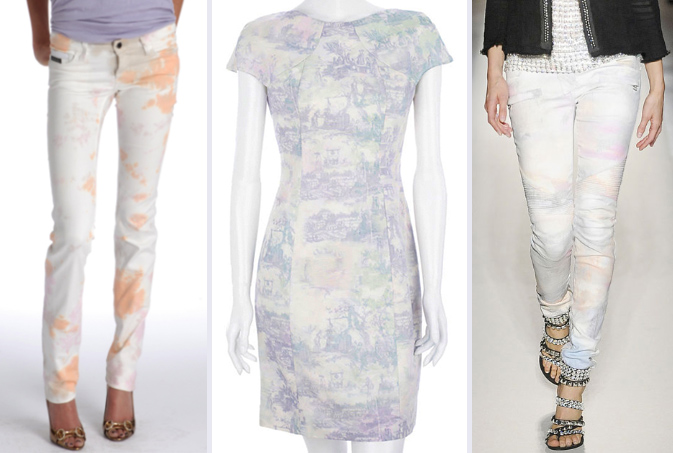
It appears that many designers are embracing bleach this coming season.  From the elitist corners of couture to the wider ranges of mass market, styles are purposefully paler, if not washed out, this spring. Paring pastel tie dye with white denim, Members Only has tapped eighties color palettes to create abstract graffiti slacks.  Moving in a more feminine direction, Erdem’s Lucina Tailored Dress is a modern remake of traditional French toile fabric.  Balmain, a rising favorite among fashion circles, merges these two concepts to create a hybrid of luxury denim.

faded-signage

When discussing how faded motifs are woven throughout our everyday lives, it’s interesting to note the natural wear and tear that occurs in metropolitan environments.  Be it an old wall in Paris, a faded stop sign in Ohio or the remnants of a house in Melbourne, all of these “eye sores” contain beautiful details that progressive observers tap for inspiration.  Peggy Noonan of the Wall Street Journal boldly predicts that we’ll be seeing rougher streets as city budgets dwindle in her article entitled, Goodbye Bland Affluence.  So we ask, are designers subconsciously glamorizing the decline of urban city living?

Follow-up: Graceful Graffiti


moschino-graffiti

Graceful graffiti recently made its debut on Pattern Pulp, showcasing a wide array of spray painted home goods and beauty products.  Each item revealed a hint of edge, proving that high and low art forms are becoming the norm.  While on a recent shopping trip, I fell head over heels for this polka dot Moschino dress.  Though it’s not necessarily for the conservative types, it certainly speaks to the experimental dresser who’s both willing and welcoming of the spotlight.

Tracking Repetitive + Awesome.
On Instagram.