
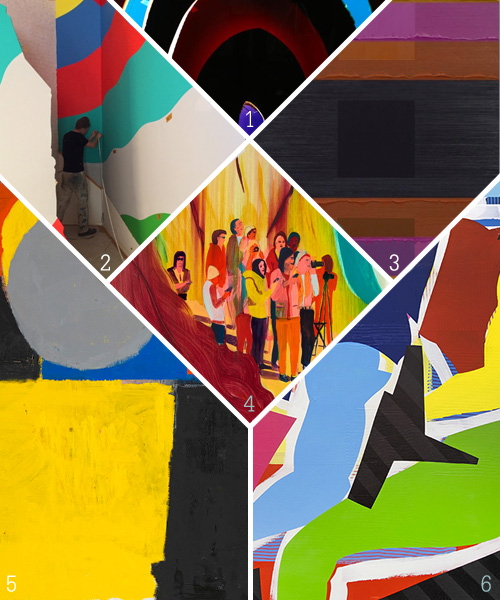
This week’s artists examine the places where inner and outer worlds collide and form communication.
* * *
1. A pioneer in what could be called photographic abstract expressionism, Liz Nielsen audaciously experiments with photographic process, expressing her individual psyche while attempting to tap into universal sources of imagination. Even when creating images based on visual realities, Nielsen favors a highly abstracted mode. In her latest show, The Medium she has created pictures at a larger scale than was previously possible for her and which allow her to further explore the expressive potential of color. Reflective and cerebral, Nielsen’s pictorial notions make an elemental impact somewhere between the luminous and the sublime at Danziger Gallery
2. Meeting, for the first time in a European institution, Swoon, Maya Hayuk, MOMO and the artistic duo FAILE offer a multi-dimensional picture of culture 2.0, the cosmopolitan spirit of the museum. The exhibition highlights the relationship between the artist’s own aesthetic and his desire to communicate with his audience at The Millenium Iconoclast Museum of Art
3. The Ocular Bowl examines vision through physical manifestations of light and sight lines, metaphorical symbolism and transcendental themes. The works include build upon conflicting attitudes about belief at Kayne Griffin Concoran
4. Jules de Balincourt’s practice occupies a distinct emotional hyperspace, ranging with easy fluency across abstraction and figuration, collective imagination and singularized perception to make idiosyncratic connections within the landscape of contemporary westernized culture at Victoria Miro
5. Joe Bradley on his work: “I think that painting relates very neatly to inner travel and the exploration of inner worlds. With painting, I always get the impression that you’re sort of entering into a shared space. There’s everyone who has painted in the past, and everyone who is painting in the present.” at Gagosian
6. Maser combines his experience as a graffiti artist with his formal art education to develop this singular body of work, balancing hard-edged blocks of neon color that congeal into expressive, figurative compositions. “Orbiting on the Periphery” continues Masers’ exploration into the philosopher and mathematician Thales of Miletus’s theory; “mens sana in corpore sano,” in which physical health and condition are recognized as an essential part of psychological equilibrium at Lazarides Rathbone
