Pattern Pulp

Tuesday's Gallery Picks


gallerypicks_patternpulp150

This week’s artists use shape to evoke deeper thought and play.

*            *            *

1. Raoul De Keyser’s subtly evocative paintings appear at once abstract and figurative. Made up of simple shapes and marks, they invoke spatial and figural illusions, yet remain elusive of any descriptive narrative at David Zwirner
2. Hans Hofmann’s famous phrase “push and pull” is most often associated with the Abstract Expressionist painter’s signature works of the 1950s and 1960s, in which bold color planes emerge from and recede into energetic surfaces of intersecting and overlapping shapes. Employing color, plane, and space, Hofmann sought to achieve creative expression that paralleled nature at BAMPFA
3. Tom Hackney has created geometric abstractions based on the movement of pieces in games of chess. In the case of the present exhibition, they are games played by the celebrated French artist and chess player, Marcel Duchamp at Francis M. Naumann Fine Art
4. A retrospective of at textile artist and interior designer Alexander Girard’s oeuvre Vitra Design Museum
5. Gabriel de la Mora’s art practice subverts function through contemplative and systematic modes of enquiry. For De la Mora, art is neither created nor destroyed, only transformed. The artist collects materials that have been discarded after their manufactured function ceases to exist, and these form the basis of his two- and three-dimensional works at Timothy Taylor
6. Karen Carson’s seminal Zippers series at Rosamund Felson

Tuesday's Gallery Picks


gallerypicks_patternpulp139

This week’s artists use color to explore relationships in all of its forms.

*            *            *

1. Tom Krumpak’s Bamboo tall, blue sky, a painted abstract picture, inside wooden room is comprised of a body of work, inspired by the relationship between Mid-20th-Century Modern architectural design and traditional Japanese Shoji screened dwellings found in the United States and Japan at Lora Schlesinger Gallery
2. Concrete Cuba is one of the first major presentations outside of Cuba to focus exclusively on the origins of concretism in Cuba during the 1950s, and will include important works from the late 1940s through the early 1960s by the twelve artists who were at different times associated with the short-lived group at David Zwirner
3. Zhu Jinshi All the works in the exhibition are accumulations of Chinese aesthetic and socio-political histories and hard labor, drawn from the artist’s experience growing up during the Cultural Revolution at Blum & Poe
4. The genesis of Agathe de Bailliencourt’s Couleurs du temps is rooted in a three month residency in Marfa, Texas in 2014. Marfa’s extraordinary landscape and desert environment had a profound impact on Bailliencourt’s notion of time, space and horizon. The new paintings produced in Berlin continue her reflections on these concepts, with the artist questioning ‘what does it mean to paint a landscape today?’ at Blain|Southern
5. In Odili Donald Odita’s The Velocity of Change, the artist “hope[s] to engage the intrinsic power of color in its ability to escape the definitions of language that limit and paralyze” at Jack Shainman Gallery
6. In Color Matters, the artworks examine how color relationships function, on many levels, with their own logic. By definition, the first, or root, level of color usage is the purely abstract manipulation of the element of color for its own sake. It can be perceptual, realistic, theoretical or symbolic at The Painting Center

Tuesday's Gallery Picks


gallerypicks_patternpulp108

In this week’s gallery picks, process, pattern and color reign supreme.

*            *            *

1. Rosson Crow has long been fascinated by history and the psychology of interior spaces, and has addressed subjects as varied as French Revolutionary interiors, New York City graffiti and the films of Alfred Hitchcock in his work. This exhibition represents Crow’s response to the paintings of Florine Stettheimer and debuts a new technique of Xerox transfers layered with painting on the canvases at Sargent’s Daughters
2. Richard Hull calls his recent paintings and drawings “stolen portraits.” His crayon drawings, in particular, are portraits in the form of hairdos, each one expressing a distinct visual personality rather than a representation of a particular individual at Western Projects
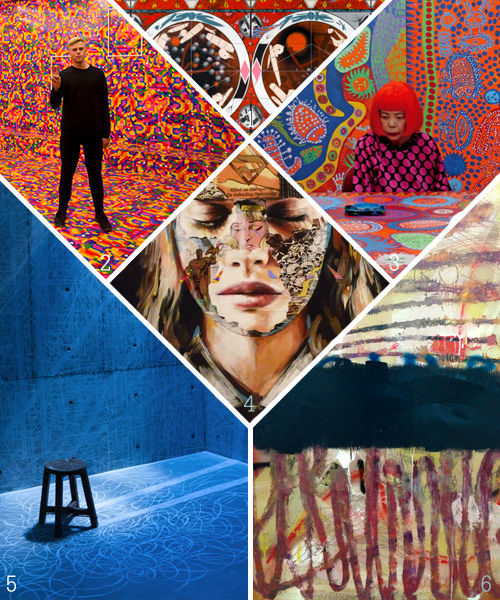
3. The bold brushstrokes and swirly shapes in Yayoi Kusama latest works seem to hover between figuration and abstraction; vibrant, animated, and intense, they transcend their medium to introduce their own pictorial logic, at once contemporary and universal. As such, while they continue Kusama’s innovative exploration of form, subject matter, and space, they also represent a connection to her work from the past six decades at David Zwirner
4. In James Little’s new paintings, color and structure are critical fixations that complement his geometric pictorial style.  The edges of his vertical bands are saturated with lucid color as they give way to other patterns – chevrons, rectangles and zigzag designs of varying widths at June Kelly Gallery
5. By folding, tearing, and combining, Yun-Woo Choi obfuscates the meanings constructed in two-dimensional printed material in an attempt to deliver intuitive feelings to the viewer at Open Source Gallery
6. Carlos Estrada-Vega’s paintings are composed of more than 300 blocks of color. Considering each as an individual brushstroke, Estrada-Vega proceeds to compose his paintings intuitively, mounting these pieces onto metal plates using magnets at Margaret Thatcher Projects

Tuesday's Gallery Picks


gallerypicks_patternpulp35

This week’s exhibitions have a confined and restricted feel at first glance – but are they?

*            *            *

1. Lari Pittman’s compositionally dense works play with the social and current realities of today, with an interest in ornamentation and surface, and draw on the legacy of history as told through the Western canon of painting and the applied arts at Regen Projects
2. Images of fantasy goddesses are hidden within Siggi Eggertsson’s densely patterned walls, ceiling and floors in his latest show at Spark Design Space
3. Yayoi Kusama’s I Who Have Arrived in Heaven at David Zwirner
4. Sandra Chevrier’s series “cages” is about women trying to find freedom from society’s twisted preconceptions of what a woman should or shouldn’t be. These women encased in these cages of brash imposing paint or comic books that masks their very person symbolizes the struggle that women go through with having these false expectations of beauty and perfection as well as the limitations society places on women, corrupting what truly is beautiful by placing women in these prisons of identity. By doing so, society is asking them to become superheroes at Reed Projects
5. “Burning Chair,” Takashi Ishida’s most recent work, was created by shooting one frame at a time to produce a “moving image” of drawing animation, in which a natural line propagates itself like a wave. Ishida drew on a wall and floor made of concrete with chalk, then sprinkled water over his drawing to erase the chalk lines. The water dried out and disappeared, creating a repetitious image; the use of such malleable materials on concrete surfaces only emphasizes the image’s generation and disappearance at Taka Ishii Gallery
6. Themes of authority, control and power feature heavily in both the technique and content of John Tsombikos’ latest show, commenting upon political and social frictions while presenting a progressive transition from graffiti into an unforgiving body of new work at Lazarides

Tuesday's Gallery Picks


gallerypicks_patternpulp4

This week’s gallery picks explore global and cultural issues in diverse textural form.

*            *            *

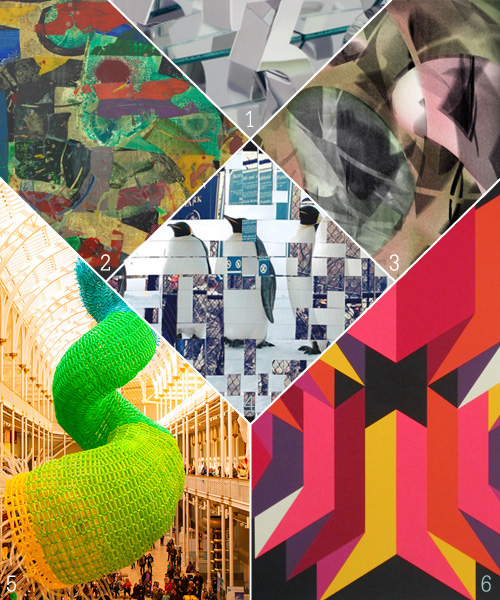
1. Steven Baldi takes over this week at “Territory” at Thomas Duncan Gallery
2. Scott Olson’s painting practice is rooted in a deep fascination with painting’s materials, tools, and history at Wallspace
3. Thomas Ruff’s abstract “photograms” and “ma.r.s” photographs at David Zwirner
4. Rachel Owens creates fascinating patchworks that address global and environmental concerns at Track 13 Gallery
5. Jason Hackenwerth’s Pisces sculpture is made out of 10,000 balloons at Edinburgh International Science Festival
6. Andrew Kau’s striking chart paintings in “You Say Tomato” at Malborough Chelsea


New York: Michael Riedel's Text Displays


Michael Riedel is known for using text as his source material and utilizing a wide range of media to examine interesting effects. His latest exhibition features silk-screened “poster paintings,” which were created by accessing websites where his works were mentioned.

By first highlighting, then copy and pasting the text into InDesign, the words appear in a linear but nonsensical order. Included are algorithmic commands, search keywords, and links, intermixed with miscellaneous sentences on the artist, copyright phrases, and contact information. The portions are affixed with circular shapes that resemble the ever-dreaded spinning wheel computers display when processing too much information at once.

The posters are hung on wallpaper covered in text from the gallery’s website creating an interesting text-based art experience. The quirky and playful title, a pangram generally used display typefaces and to test typewriters and computer keyboards, is used here to underscore the staccato relationship between text, canvas, paper, and architecture. For more info, click here.

Opening: February 17th 6:00 PM – 8:00pm

David Zwirner
533 W. 19th Street
New York, NY 10011

Tracking Repetitive + Awesome.
On Instagram.