Pattern Pulp

Artist Profile: Julien David


Graphic designers get really excited when the art world a.) beautifies and b.) acknowledges their daily design tools. Today we present you with Julien David and his most recent collaboration with Pringle of Scotland, Colette and DC Comics. Using bold illustrations, vivid colors and rich fabrics, David single handedly creates a playful dialogue for the luxury market to wrap it’s head around. The symbolism behind the keyboard and Superman logo remind us of the importance and influence both images hold on a global scale. By enlarging and repeating, we see how easy it can be to force an audience to heed a message. Whether you’re wearing a twinset or a scarf, all of David’s pieces are conversation starters, not to mention, exciting interpretations of pop culture.

Social Media: Tag, you’re it!


Ahh, the good ol’ school days where slapping someone on the back during recess gave them the opportunity to slap someone else. Well, tagging these days has matured from playgrounds to the web-interface, but it has maintained it’s most fundamental element: its social counsel.

What, you may ask? How did a semi-violent, super competitive child’s play transform into the Web 2.0 system of classification system? Truth be told, it didn’t; yet, the game of tag identifies someone as a leader of a social context (even if you were super fast in Pre-K and immediately purged yourself of being ‘it’) and tags today identify information as important through a social media context.

Tagging, which we have all come to know, love and ubiquitously use, is a Web 2.0 (or semantic web) ontological system of classification system. Yikes, that sounds scientific jargon heavy.  Basically, remember the ancient days of clunky Netscape and the Internet Bubble Burst of 2001? Well, after many dot com-ers saw their dreams being crushed, some intrepid programmers, who weren’t ready to give up, revolutionized the Web platform. More specifically, a man who is still a preeminent web innovator today named Tim Berners-Lee created an interface system that incorporates artificial intelligence to make humans and computers understand the same language (hence the semantic part).  For Web 2.0 to work seamlessly, bits of information have to be classified by a controlled set of vocabulary that humans determine and computers understand; these are known as ontologies.  And for those of us who suffered through freshman-year Philosophy of the Mind, ontology should ring a bell as the study of existence.

The geek in you cares about web 2.0 because it is the reason why we have smart phones, cloud computing, Google and Facebook. Web 2.0 allowed thousands of us to make web pages, start blogs and create social networking spaces (raise your hand if you were on Friendster!); the onslaught of content on the Web made its organization rather difficult to keep orderly and well, necessity is the mother of all invention, right? Say hello to the Tag. They started as bookmarks on del.ici.ous and spread like wildfire with the emergence social software sites, such as Flickr, YouTube, blogs and now, Twitter.  The reason? For the people, by the people.  Tags are user-generated, community-driven classification labels that do not rely on traditional methods of taxonomy or The-Man telling you what’s important.

Tags are written in the speech of the community it reflects and promotes information that the community deems as necessary, essential or just plain freakin’ funny.  Don’t take it from me; entire IT university departments have conducted research on this very particular topic and have repeatedly demonstrated that tags are the voice of the people.  But, tags actually go deeper than that, I say.  In fact, keywords chosen for tags offer a personal reflection and analysis of the presented information— no, not some Freudian deconstruction of the matter at hand, but rather a counsel or phenomenon deeply embedded in to our culture.

Many of us when we tag our blogs, Flickr or Tweets have been known to just slap on a tag like ‘art’ or ‘pretty things’ or ‘funny’ but even those tags reflect values of our culture.  As our lives become more and more enmeshed in the Web interface (just look at the prevalence of social media as business mechanism or the fact that Obama tweets…), tags refer to staple cultural proverbs, anecdotes and other defining phenomenon.  The ones from the days before the Internets– the values of our culture that no semantic ontology can recognize, even if it can ‘understand’ the words.  My M.A. writing professor always said, “information dies on the page” (although, I’m sure he stole that from cultural theorist Walter Benjamin), but tags are a parting memento, a stamp of our values in the web-o-sphere. It’s as if tags are storytellers or the new oral tradition a la Homer or the wandering Minstrel.

Now, this may sound entirely loony, there has been a prominent trend, one hard to ignore. If you don’t believe me, here are few examples:

We live in an information-rich, real-time mentality these days; most of us toting a Blackberry or an iPhone, constructing the future as our own and quick to forget the past. So, while no computer or code-program can ever understand what “kids these days means” or “you can run…”, they will enable the permanent storage of those sayings.  Tags can always draw us back to the lessons and values (even wives-tales!) instilled in us during childhood, the very ones we probably overheard while playing tag.

Coverage by: Julie Baumgardner

New York: SMartCAMP


There’s no doubt social media was created for our social endeavors – staying in touch, sharing information, etc. – but unless you’ve been living under a rock, it’s no secret that this interactive medium has exploded in corporate and branded spheres.

But how does it relate to the arts? Social Media Art Camp (SMartCAMP) is a conference that focuses on the social web and its relation to the arts community. Come learn how these tools are being utilized by artists and creative organizations to build vibrant communities throughout the globe. Whether you’re new and skeptical about the power of social media or presently engaged in one or more online platforms and want to further your knowledge, SMartCAMP’s presentations aim to be insightful as the list of speakers is quite impressive.

Roger Smith Hotel: 501 Lexington Ave., New York, NY 10017

Artful Antfarms and Social Media


artful-antfarms

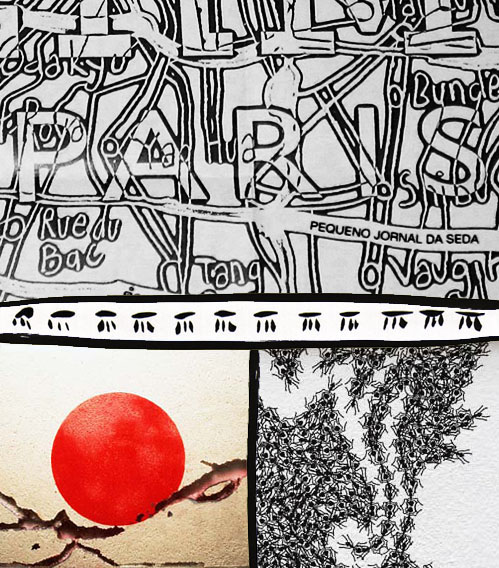
What do ants, art, fashion and social media have in common? We’ve been asking that very question ever since reading Noah Brier’s fascinating take on the power of colonization and it’s relation to the internet. The idea that “ants don’t really ever exist on their own, all their power comes from their ability to organize themselves in groups,” directly parallels social media’s impact online, particularly in relation to traffic, viral marketing and cross pollination.

The use of ant farms to contextualize larger societal microcosms have been popping up in every media form, from literal depictions in Mad Men to more abstract print parallels, such as this Hermès map of Paris. Toying with the idea of national identity and cross pollination, Japanese artist, Yukinori Yanagi brilliantly displays the world through the eyes of  the ant in his 1990 installation entitled, The World Flag Ant Farm. Using a series of interconnected boxes, each filled with colored sand in the pattern of a national flag, Yanagi releases a colony of ants into the system, allowing them to travel freely. “The border crossings” result in an intermingling of color throughout the system, a stunning visualization of our cross-cultural networks. Bringing this concept to the masses on a more playful scale, Stine Gam and Enrico Fratesi merge ant farm living with brocade wallpaper patterns, proving mass mobilization can create tangible and beautiful results.

By: Shayna Kulik

Coralie's Cloth-Bound Covers


Coralie Bickford-Smith-patterns

A week ago, our good friend Alexandra Machinist, a Manhattan based literary agent passed along a link to Coralie Bickford-Smith‘s beautiful cloth bound book covers.  While these beauties have been on the market for a year now, nostalgia for hard cover classics is somewhat recent with the growing success of digital aggregators, such as the Kindle.  Smith’s series is now available in the US and to celebrate the launch, Design*Sponge recently conducted an interview the artist, exploring her process from concept to production. Be it Shakespeare’s Sonnets or The Gothic Horror series, sentiments for a lost art form are reminding us why hard covers deserve a spot on your livingroom shelf.

By: Shayna Kulik

Trend: Virtual Baggage


virtual-baggage

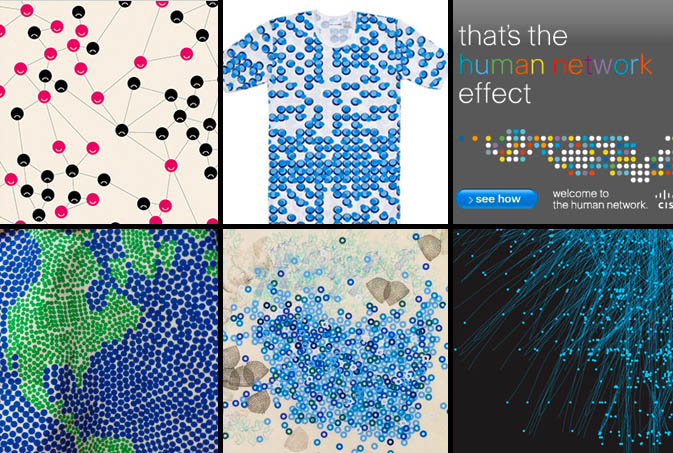
These days, who doesn’t live life on the go? The ease at which we consume information keeps us moving from one task to the next, allowing us to jump through ideas, facilitate conversations and share moments. With the use of our mobile devises and computers, we are able to navigate through unlimited technology with minimal strain on our physical being. Dr. Susan Blackmore describes this information transferral process in her TED presentation, touching upon evolutionary theory, consciousness, replication and idea convergence between humans and technology. Blackmore, like others, is part of a research movement that’s focused on studying how trends, ideas and epidemics spread throughout human and digital communities.

In visualizing these theories, we have pulled dot-inspired imagery from relevant print, fashion and web sources. Are Your Friends Making You Fat? is a recent NYTimes piece by Clive Thompson which focuses on social contagion in the world of networking.  Merging fashion with technology, Commes de Garcon embraces pointillism with this atom inspired undershirt. Cisco insinuates global communication using colorful dots while Stella McCartney pares down to blue and green with her Whatever It Takes tote. Nancy Macko adds a truly organic touch with her artful study of the honey bee and Tatiana Plakhova embodies the idea of networkism in her two-toned fiber optic-looking graphic.

Collaborative coverage by: Kelsey-Lee LeGassick and Shayna Kulik

Tracking Repetitive + Awesome.
On Instagram.