Pattern Pulp

Tuesday's Gallery Picks


gallerypicks_patternpulp140

Exploring overlaps and contrary concepts in this weeks gallery picks.

*            *            *

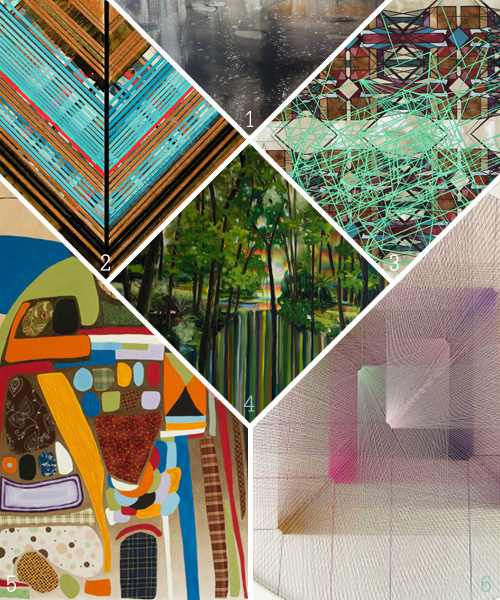
1. While the natural world plays a profound role in Matthias Meyer’s work, he achieves in its depiction a synthesis between the representational and the abstract. Both mysterious and revealing, the water’s surface reflects its surroundings while simultaneously drawing the viewer’s attention into the depths beneath at Danese Corey
2. “Pulling imagery and motif from organic form, architecture, media and design I create densely layered, mixed-media paintings that are invested in process and grounded in traditional craft. I’m interested in the overlap of nature and culture and the patterns present in both; the tension between them drives my exploration of color, surface and materiality.” – Nina Tichava at George Billis Gallery
3. Gao Rong has navigated notions of femininity and identity through domestic architectures in her previous series in which she created facsimile houses, rooms, and sites of memory rendered entirely in embroidered thread. Rather than romanticize the handicraft, however, Gao threads narratives together painstakingly through these embroidered fabrics, sometimes mimicking the act of suturing a wound. For her current solo exhibition, The Simple Line, Gao condenses this process into abstract hoops that dissect the tensions between formalist styles and traditional folk craft indigenous to female domestic life in China at Klein Sun Gallery
4. David Lefebvre manipulates his landscape paintings Galerie Zurcher
5. Rock and Refuge, Carol Es’ latest exhibition, will include her Joshua Tree paintings as well as a drawing installation from her ongoing Journal Project at Craig Krull Gallery
6. Tony Ingrisano’s practice draws inspiration from various infrastructure systems, from man-made power grids to naturally occurring river circuits. Ignoring their intended functionality, Ingrisano instead focuses on the beauty and rhythm found within their forms. The work presented in this exhibition furthers Ingrisano’s exploration of the aesthetic possibilities surrounding organizational systems by expanding into the theoretical. His interest lies specifically within geometric perspective and what a breakdown of the rules governing that perspective can add to the discourse about systems at Lesley Heller Workspace

Tuesday's Gallery Picks


gallerypicks_patternpulp139

This week’s artists use color to explore relationships in all of its forms.

*            *            *

1. Tom Krumpak’s Bamboo tall, blue sky, a painted abstract picture, inside wooden room is comprised of a body of work, inspired by the relationship between Mid-20th-Century Modern architectural design and traditional Japanese Shoji screened dwellings found in the United States and Japan at Lora Schlesinger Gallery
2. Concrete Cuba is one of the first major presentations outside of Cuba to focus exclusively on the origins of concretism in Cuba during the 1950s, and will include important works from the late 1940s through the early 1960s by the twelve artists who were at different times associated with the short-lived group at David Zwirner
3. Zhu Jinshi All the works in the exhibition are accumulations of Chinese aesthetic and socio-political histories and hard labor, drawn from the artist’s experience growing up during the Cultural Revolution at Blum & Poe
4. The genesis of Agathe de Bailliencourt’s Couleurs du temps is rooted in a three month residency in Marfa, Texas in 2014. Marfa’s extraordinary landscape and desert environment had a profound impact on Bailliencourt’s notion of time, space and horizon. The new paintings produced in Berlin continue her reflections on these concepts, with the artist questioning ‘what does it mean to paint a landscape today?’ at Blain|Southern
5. In Odili Donald Odita’s The Velocity of Change, the artist “hope[s] to engage the intrinsic power of color in its ability to escape the definitions of language that limit and paralyze” at Jack Shainman Gallery
6. In Color Matters, the artworks examine how color relationships function, on many levels, with their own logic. By definition, the first, or root, level of color usage is the purely abstract manipulation of the element of color for its own sake. It can be perceptual, realistic, theoretical or symbolic at The Painting Center

Tuesday's Gallery Picks


gallerypicks_patternpulp138

Our artists contemplate the ability of the world to transform in this week’s gallery picks.

*            *            *

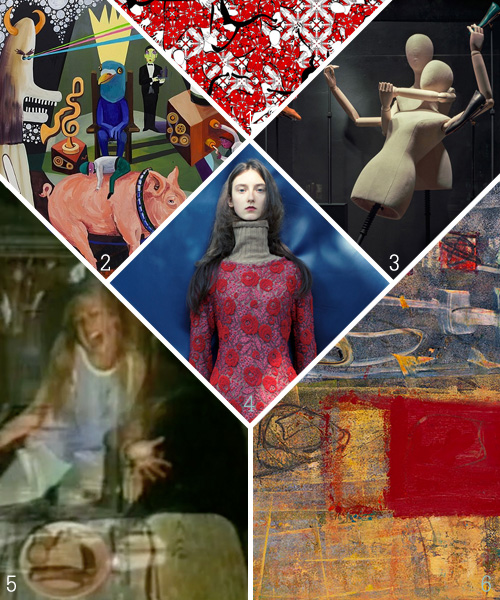
1. “The Colossalalia paintings are a rogues’ gallery of old Los Angeles neighborhoods. They serve as visual signposts to a landscape vaguely recalled, or no longer extant. As neighborhoods change through neglect, destruction or development, these paintings remain as souvenirs of a world systematically being erased” – Hilary Baker at Offramp Gallery
2. Mark Ryden’s latest series is informed by the geometric structure “dodecahedron,” a solid figure bearing 12 sides whose perfect symmetry has been the source of extensive query by mathematicians and scientists since antiquity. Drawing upon the form’s mystery and divine connotations as a source of inspiration, Ryden explores the bridge between the physical world and the intangible realm at Paul Kasmin Gallery
3. The vocabulary of images in Mark Ryden’s new body of work remains consistent with his pervasive distortion of scale and his iconic fairytale-like creatures set against seductive landscapes of untouched beauty. However, the subject of his latest series is informed by the geometric structure “dodecahedron,” a solid figure bearing twelve sides whose perfect symmetry has been the source of extensive query by mathematicians and scientists since antiquity Ron English’s Neonature examines the art of evolution, the flaw that propels civilization at Corey Helford Gallery
4. Examining the evolution of the feather at Andrea Rosen Gallery
5. Both David Marc Grant and Adrian Landon Brooks are influenced by the notion of time – past, present and future. Grant continues to explore the idea of a mythical future world in his series of acrylic paintings on wood panel. In contrast, Brooks is inspired by materials and aesthetics of past eras at Campfire Gallery
6. Whitney Bedford’s exhibition will include a series of uniformly scaled landscapes; these images of a tropical desert form an exploration of the sublime, of Eden, of the origins of awe in nature, that hints at the cinematic. Bedford will also present a trio of monumental landscape paintings rendered in gold ink with her exemplary draftsmanship and painterly exuberance at Susanne Vielmetter Los Angeles Projects

Comparisons + Visual Cues


elephant_covernyc_ballet_advert

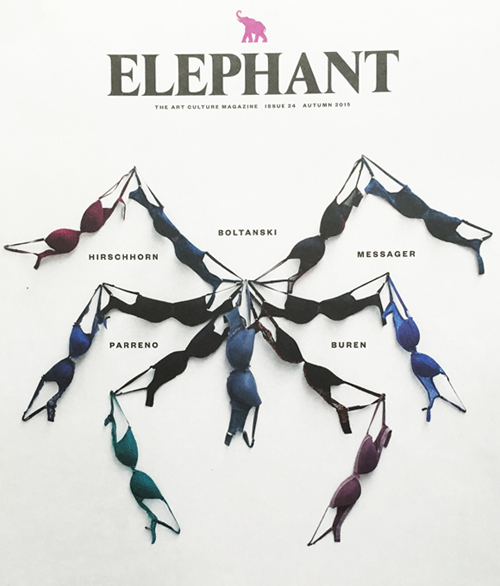
In a world where we’re constantly consuming content in various mediums, it’s hard not to draw comparisons on an image-by-imgae basis. As you scroll through instagram, it’s interesting to see similarities between posts, especially when there’s no geographical or thematic connection between the accounts.

These two printed pieces struck me in a similar way, as they share a familiar energy yet come from divergent design worlds. Elephant is an art and culture magazine that’s printed and produced in the UK. It has fantastic coverage of the art world. Just below, is the New York City Ballet‘s Fall advertising campaign. In describing both spreads, they feel lyrical, lanky and muted. Do you also see a common thread?


Tuesday's Gallery Picks


gallerypicks_patternpulp137

This week’s gallery picks examine intersections of reality, space and influences.

*            *            *

1. This idiosyncratic selection looks at the diverse ways in which notions of inner and outer space are perceived and utilized as a topic within artistic practice at Edward Thorp Gallery
2. Ilya & Emilia Kabakov’s new collaborative series The Two Times explores layered or dual realities, a prominent theme within the Kabakov’s work. Representations of a distant, classical past are spliced with images of fragmented memories from the Soviet era, conveying the collision of two time periods. The multi-layered interpretations emphasize human perceptions of time and the temporal nature of the present, which is constantly emerging from and turning into the past at Pace Gallery
3. A winter group show with an otherworldly vibe at Joseph Gross Gallery
4. Matt Wedel’s Peaceable Fruit comes out of a larger interest in landscape within his work and is a kind of hopeful signifier and idealized blueprint in understanding the future of humanity at La Louver
5. In his ongoing investigation of his intimate environment, Jonas Wood fuses artistic influences as diverse as the domestic interiors of Pierre Bonnard, Henri Matisse, and David Hockney to Chinese and Japanese still-life scenes, ancient pottery and the guileless textiles of Josef Frank. Sampling subjects from his own photographs, he reiterates them through an intensive process of drawing. Filling the compressed spaces of his paintings with figures, plants, and household objects, Wood reimagines the world as a variegated collage of overlapping patterns, flatly rendered at Gagosian London
6. Erik Parker’s Undertow offers insight into the evolution of Parker’s work over the last two decades. Parker continues to critically chart the world’s current political, social, and economic landscapes with compositions brimming with references to media, popular culture, music, and art history. Synthesizing multiple elements from his myriad styles into new dynamic compositions, the artist works at breaking down the metanarratives of late modernist painting while simultaneously digesting the pictorial chatter of scrolling feeds of social media at Paul Kasmin Gallery


Tuesday's Gallery Picks


gallerypicks_patternpulp137

This week’s artists examine the psyche and culture’s impact on how we see the world.

*            *            *

1. Parastou Forouhar’s practice examines the power structures within certain authoritarian political systems, with particular attention to how they block oppositional discourse from entering the public sphere and the partial invisibility of women through veiling. Through her work, she processes very real experiences of loss, pain, and state-sanctioned violence through animations, wallpapers, flip-books, and drawings at Pi Artworks
2. Stefanie Gutheil has delved deep into the recesses of her imagination and emerged with a phantasmagoric stable of characters à la a secularized and hallucinatory version of Noah’s Arc. With this herd of misfit creatures, Gutheil has left normality at the door and transformed the gallery into a sanctuary of the bizarre – a surreal, utopic landscape of chromatic and psychological vibrancy. In their peculiar features and with their hearts on their sleeves, Gutheil’s oddballs all emit a vaguely familiar sense of the folkloric, as if the artist unraveled them from traditional fables and stitched together her own at Mike Weiss Gallery
3. Brian Ulrich’s new body of work that reveals the excesses of luxury consumerism and America’s love affair with perception of wealth at Robert Koch Gallery
4. Characterized by her exquisite use of light, formal elegance, and palpable psychological tension, Helen Van Meene’s depictions of girls and boys on the cusp of adulthood demonstrate a clear aesthetic lineage to seventeenth-century Dutch paintingat Yancey Richardson
5. A prolific artist who lived between New York and London, Ellen Cantor combined ready-made materials with diaristic notes and drawings to probe her perceptions and experiences of personal desire and institutional violence at The Watts Institute
6. Lisa Pressman believes her paintings embody a visual synthesis of stored memory – a metaphorical representation of the passage between human vibrancy and entropy at Causey Contemporary

Tracking Repetitive + Awesome.
On Instagram.