Pattern Pulp

Tuesday's Gallery Picks


gallerypicks_patternpulp150

This week’s artists use shape to evoke deeper thought and play.

*            *            *

1. Raoul De Keyser’s subtly evocative paintings appear at once abstract and figurative. Made up of simple shapes and marks, they invoke spatial and figural illusions, yet remain elusive of any descriptive narrative at David Zwirner
2. Hans Hofmann’s famous phrase “push and pull” is most often associated with the Abstract Expressionist painter’s signature works of the 1950s and 1960s, in which bold color planes emerge from and recede into energetic surfaces of intersecting and overlapping shapes. Employing color, plane, and space, Hofmann sought to achieve creative expression that paralleled nature at BAMPFA
3. Tom Hackney has created geometric abstractions based on the movement of pieces in games of chess. In the case of the present exhibition, they are games played by the celebrated French artist and chess player, Marcel Duchamp at Francis M. Naumann Fine Art
4. A retrospective of at textile artist and interior designer Alexander Girard’s oeuvre Vitra Design Museum
5. Gabriel de la Mora’s art practice subverts function through contemplative and systematic modes of enquiry. For De la Mora, art is neither created nor destroyed, only transformed. The artist collects materials that have been discarded after their manufactured function ceases to exist, and these form the basis of his two- and three-dimensional works at Timothy Taylor
6. Karen Carson’s seminal Zippers series at Rosamund Felson

Tuesday's Gallery Picks


gallerypicks_patternpulp149

This week’s artists take things apart to put them back together.

*            *            *

1. In drawing from the urban storefront and its familiar yet overlooked signage, Brice Bischoff’s installation of photographic and architectural structures, videos and fiberglass sculptures considers how the experience of place is shaped by way of light, reflection and architecture at Cirrus Gallery
2. Jason Middlebrook’s signature towering “Plank” paintings are geometric abstractions painted directly onto internally cut trunks from the local mill in Hudson New York. Middlebrook’s signature patterning weds the geometry of modern abstraction with the lines of wood grain to “create a tension between something organic and something man-made.” at Gallery 16
3. WILDSCAPES examines two distinguished artistic approaches to depictions of nature, with a focus on ecological (dis)balance between the natural and the man made world. By utilizing different materials, aesthetic approaches and iconographies, Ivan Stojakovic and Paula Winokur deliver compelling takes on wilderness and its fragility and/or pertinence within contemporary cultural context. They reinvent the notion of the sublime, dwell on the ways both nature and culture are fabricated, contemplate on their coexistence and clashes, and call for reflection on the existential and ecological issues of our times at Christian Duvernois Gallery
4. Arman’s Accumulations features around forty historical sculptures produced between 1960 and 1964. In his quest to construct an ‘archaeology of the present’, Arman created an artistic language that had a deep-reaching effect on contemporary art. The Accumulations explore the loss of individual identity and the neutralization of human interactions by consumer society, the violence of abundance and the aesthetics of rubbish at Galerie Daniel Templon
5. Extending and intensifying the method of image making (and unmaking) that he has employed for a decade, John Sparagana has spent the last two years deep in the comics, with very serious results. His most ambitious and accomplished work to date, the Themesong Variation works, which are technically cut paper collage of 1/8-inch squares mixed and laid down onto Dibond aluminum, open a whole new universe of potential for image intervention and reinvention at Corbett vs. Dempsey
6. Roddy Wildeman sees beauty in distressed and damaged surfaces and works solely with materials fitting that description. The two main focuses of Wildeman’s work are historic preservation and sustainability. He collects wood from a majority of buildings that are over one-hundred years old and have a legacy of sentimental value attached to them.Everything that enters his studio gets incorporated into a phase of his process and his studio functions at a 100% sustainable level. Committed to his social responsibility to reuse and recycle, Wildeman views his practice as an effort to preserve our environment at Jonathan Levine Gallery

Tuesday's Gallery Picks


gallerypicks_patternpulp148

In this week’s gallery picks, women play the narrative.

*            *            *

1. Susanna Bauer and Leigh Anne Lester’s muses are the found fallen leaves, and the buds of flowers that haven’t fully grown.  Marrying both human and nature again, their work is a tribute to nature at Muriel Guépin Gallery
2. Carrie Moyer’s Sirens explores and extends the legacy of American Abstraction while paying homage to many of its seminal female figures among them Helen Frankenthaler, Elizabeth Murray, and Georgia O’Keeffe. In Moyer’s compositions color is the sole character, playing every role: energy, matter, ooze, architecture, the cosmic and the cosmos. Through her use of gravity, velocity and stasis Moyer transforms and frees vivid primary hues to express new kinds of animation or fullness, which in turn propels Moyer’s ongoing exploration of her medium at DC Moore Gallery
3. Anna Elise Johnson collects official photographs taken during meetings between the leaders of the International Monetary Fund, World Bank, the U.S. State Department and various heads of state undergoing structural adjustment. Johnson’s acrylic sculptures structurally readjust the photographs that represent, support and solidify these imperial operations. at The Mission
4. Through nearly 100 works made by 34 artists over the past seventy years, this ambitious exhibition traces ways in which women have changed the course of art by deftly transforming the language of sculpture since the postwar period at Hauser Wirth & Schimmel
5. In new paintings and collages, Karen Kilimnik creates richly enigmatic narratives, inscribing her images with signifiers that obliquely reference histories of representation and myth. Mining the vernacular of tapestry reproductions of Baroque and Renaissance painting imagery, Kilimnik doubles down on the expressive potential of the reproduction, rendering her scenes with patchy brushwork and sprinkling her finished paintings with glitter, or adorning them with selections culled from from her library of idiomatic imagery at 303 Gallery
6. JOAN BROWN HERSELF is a survey of eleven self-portraits made between 1970 and 1980, the period during which Brown firmly established herself as an artist with a unique vision at CB1 Gallery

Tuesday's Gallery Picks


gallerypicks_patternpulp147

Contemplating patterns and paths in this week’s gallery picks.

*            *            *

1. Jerry Carniglia’s process-driven methods and exploratory nature parallel his constant and evolving search for meaning that may be found in the unseen and otherwise unarticulated structures that underlie all of existence at Chandra Cerrito Contemporary
2. In Esmé Thompson’s paintings and multi-panel wall reliefs the use of color and pattern create a dynamic and engaging viewing experience.  Colorful and bold, the paintings attest to a lifelong interest in decorative designs as diverse as those found in Islamic textiles and ceramic tiles to those of medieval paintings and illuminated manuscripts at Bowery Gallery
3. In 1905, Hilma af Klint received a ‘commission’ from an entity to create her most important body of work, The Paintings for the Temple. Consisting of 193 predominately abstract paintings in various series and subgroups, the artist painted a path towards a harmony between the spiritual and material worlds; good and evil; man and woman; religion and science at Serpentine Galleries
4. Nathan Hayden (b. 1977) dances each day to induce visions that he draws on small pieces of thick torn paper referred to as “the cards”. The shapes and geometric patterns he derives from inner and outer landscapes bounce between abstraction and figurative representation, resulting in drawings that explore personal mythologies and hallucinations. Hayden’s latest series of paintings for Pure Pretty Fever depicts hallucinatory landscapes at CB1Gallery
5. Robin Mitchell’s intensely colorful paintings are a combination of stitch-like marks layered over radiating imagery. Her exhibition, How Many Heartbeats in a Lifetime?, continues a line of visual thinking that has progressed through her previous four exhibitions at Craig Krull Gallery
6. Donald Groscost creates large paintings that challenge the viewer’s perception of the traditional medium. The show will feature his earlier works executed in the early 2000s, which are formal investigations of painterly abstraction and the process of image simulation in our digitized era. His oils on canvas deceivingly appear to be created by some form of virtual media, with a vibrancy of palette that only heightens the impression of a mechanically transmitted image at Heather Gaudio Fine Art

Tuesday’s Gallery Picks


gallerypicks_patternpulp146

Training our eyes on personality, perspective and the art of the gesture in this week’s gallery picks.

*            *            *

1. Our perception of space, our engagement with space, and through it, our interaction with each other, has never been more pertinent as a topic for exploration. Just as the adoption of perspective as a means of representing reality became synonymous with how Europe positioned itself with a view to the rest of the world in the 15th Century and beyond, so our attempts to rethink this use of perspective in art, could have a profound effect on what happens in our age, and in the future at Grimm Gallery
2. Helen Levitt’s playfully poetic photographs, made over the course of sixty years on the streets of her native New York City, are notable for the way they find delightful twists within the daily lives of her subjects. One thing that set Levitt apart from the more socially concerned documentary street photographers of her time was her focus on the body language of her subjects. Frequently what her photographs are most about are dance-like gestures; by turns elegant, or comic, and sometimes both at once at Laurence Miller Gallery
3. Menagerie showcases an eclectic body of work from some of the most recognized names in photography at Michael Hoppen Gallery
4. Anthony Lycett’s Self-Styled includes more than 200 diptychs representing eccentrics, dandies, punk, gothic, transvestites and the vanguard of London and Paris at Isabelle Gounod Gallery
5. Within seemingly vacant, haunted domestic and public spaces, Farley Aguilar’s distorted characters populate familiar scenarios of unrest, disquiet, and active protest. There are hints of the figures looking outward, beyond their present conditions, but they remain static and dazed at Spinello Projects
6. The Age Of Innocence compares Andy Rementer’s urban tales to Fulvio Mendini’s Edenic allegories, drawing attention to their shared graphic matrix, the terse tendency and the predilection for flat colors and bright hues. Both artists build a hypothetical and sublimated world, dominated by geometry, where characters, objects and places pave the way to the discovery of additional, multiple dimensions at Antonio Colombo Arte Contemporanea

Tuesday's Gallery Picks


gallerypicks_patternpulp145

This week’s gallery picks dip into the environments we create and inhibit.

*            *            *

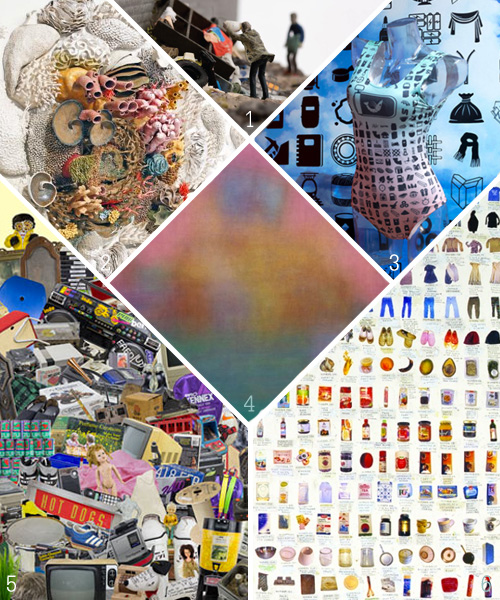
1. Twelve artists explore the psychological impact of recreating the world in tiny proportion and offer viewers an opportunity to Feel Big, Live Small in this multi-media exhibition. This display includes more than twenty works of art comprised of three-dimensional miniatures as well as photographs, digital images and video created with miniature sets at The Mini Time Machine
2. Artist and ocean advocate Courtney Mattison creates large scale ceramic installations and sculptures inspired by science and marine biology. Her intricate hand-crafted porcelain works celebrate the fragile beauty of endangered coral reef ecosystems and promote awareness to conserve and protect our natural world at Virginia Museum of Contemporary Art
3. The ocean makes up 71 percent of our planet’s surface. So, how is it that we know more about Mars than the marine environments of Earth? As impenetrable as the deep oceans are to humans, we imperviously live in a black box of international shipping, reducing the ocean to a surface rather than an environmental force. Martin Zurkow’s MORE&MORE is a socioeconomic, post-natural foray into the infrastructure of global trade: a systemic means to a never-ending end of economic growth at bitforms gallery
4. In his new body of work, Jason Salavon explores the ways in which infinite variation and permutation—supercharged by large networks—is the engine of our exploding digitized culture. Debuting 14 new works in a variety of media, the artist furthers his investigation of the vast visual capacity engendered by an ever-advancing social and technological landscape. With an emphasis on the recent massive exponential growth of digital data, Salavon uses pop cultural touchstones to guide us through various examples of the unbounded possibilities of this phenomenon at Mark Moore Gallery
5. Jenny Odell and Philip Buscemi create The Bureau of Suspended Objects, a series of window-like displays of objects in a cabinet of curiosities manner. Following a residency at Recology SF, Odell’s work has focused on the ways in which manufactured objects circulate from the factory to our homes, and how our sentimental attachment to objects changes their initial commercial value. The objects (whether brand new, in-use, or trash) become tools for an investigation into the ways we invest and divest values into and from material goods, and ultimately on the powers of visual merchandising at Contemporary Jewish Museum
6. Simon Evans misappropriates various characteristic tools for the objective depiction of reality, so as to compose radically subjective work. Embodying forms of dialogue between his interiority and the world, his pieces act as much as a research for the meaning to allot to individual experience, as a permanent exercise in the re-appropriation of the everyday at Palais de Tokyo

Tracking Repetitive + Awesome.
On Instagram.