Pattern Pulp

Tuesday's Gallery Picks


gallerypicks_patternpulp127

This week’s artists keep it bright, with crisp lines and a lot of pop.

*            *            *

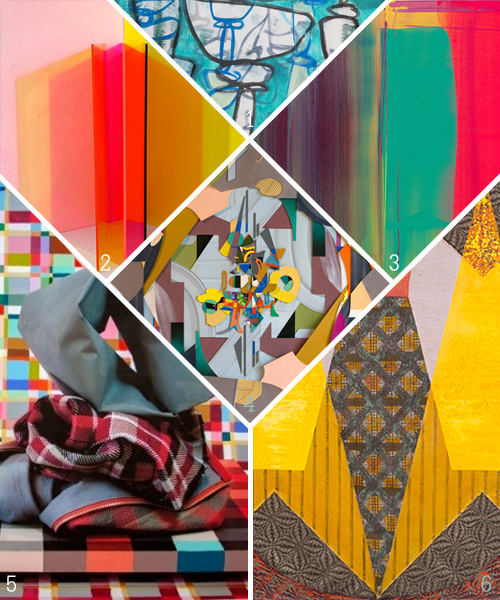
1. “The process involved in making [these paintings] is that of drawing and redrawing an image until only the most essential pieces are left.” at Joshua Liner Gallery
2. Richard Colman’s Faces, Figures, Places, & Things at Chandra Gallery
3. In Chromatic Aporias Rafael Lopez-Ramos includes realistic renderings of tropical fruits paraphrasing the gaze of colonial Art; the syncretism of Afro-Cuban religious symbols and Catholic images; and the Revolution’s propaganda iconography. Now he adds typical Americana popular culture characters, & esoteric symbols related to the American political tradition at Museum of Contemporary Art North Miami
4. Steven Harrington’s “Wavy Days” will feature 16 newly hand-painted canvases, 15 graphite drawings, 2 new sculptural works, and an exclusive screen-printed exhibition poster. The paintings present a brand new body of work that has never been exhibited, or shown within a gallery space at Colette
5. “Barbara Rossi: Poor Traits” presents a selection of Barbara Rossi’s enigmatic graphite and colored pencil drawings from the late 1960s and her meticulously rendered reverse paintings on Plexiglas from the early 1970’s at New Museum
6. The World Goes Pop will reveal how pop was never just a celebration of western consumer culture, but was often a subversive international language of protest – a language that is more relevant today than ever.at Tate Modern

Tuesday’s Gallery Picks


gallerypicks_patternpulp126

This weeks artists contemplate and expand upon their influences.

*            *            *

1. Mark Dorf employs a combination of photography and digital media in Emergence. Through his altered images of forests and mountains, Dorf scrutinizes the influence of information on the sublime, examining how we represent the natural world through the filter of science, math and technology at Postmasters
2. Elise Freda’s work in The Continuing Line uses encaustic and explores theories and painting techniques from both Eastern and Western culture, thus examining a world of contrasts: light/dark, warm/cool, surface/depth, and organic/ geometric at Causey Contemporary
3. Sisters Claudia & Julia Müller employ various processes of translation (statue becomes drawing; ceramic becomes canvas; print becomes painting) to create an oscillation between the static and dynamic at Maccarone
4. The Avant-Garde Won’t Give Up: Cobra and Its Legacy, is a two-part exhibition taking place in New York and Los Angeles which will offer a broad and critical reassessment of Cobra—an essential postwar European movement named for the home cities Copenhagen, Brussels, and Amsterdam. Cobra is frequently remembered as a style of Northern European painting—merging figuration and abstraction—that emerged in the traumatic wake of World War II at Blum & Poe
5. Dan Bayles’s The Apotheosis of Washington explores the relationship between politics and aesthetics at François Ghebaly Gallery
6. Iva Gueorguieva’s collaged paintings, works on paper, and sculptures traverse a terrain that is both physically present and illusionistic at ACME

Tuesday's Gallery Picks


gallerypicks_patternpulp125

In this week’s gallery picks, our artists explore mediums and their artistic relationships.

*            *            *

1. Choosing to work both within the figurative and more abstracted realms, Rich Jacobs crosses back & forth with no set boundary lines, or strict purism at Artists Republic
2. O’Keefe’s newest body of work, Things as They Are consists of ten photographs of distilled compositions of three boards, plexiglass and dowels that allow color and light to become the true material subject. Paradoxically, these straightforward photographs often defy understanding of how they were made or even that they are photographs at all at Denny Gallery
3. In her new work, Yunhee Min continues to explore the sensorial potential of color, light, and gesture. Movements refers both to literal and suggested motion and change: her gestures on the canvas, the viscosity of her paint, and the way these actions combine to produce a shifting spatiality within her compositions at Susanne Vielmetter Los Angeles Projects
4. The paintings, works on paper and sculpture on view in Eat A Peach are linked by saturated color, textured surfaces and replication of forms. Mirroring, symmetry and tactility suggest both growth and abundance at Jeff Bailey Gallery
5. Handmade Abstract brings together 13 emerging and mid-career artists who are dedicated to the visual language of abstraction and whose work emphasizes the handcrafted nature of the art and processes of fabrication. The exhibition will focus on work that is inspired by the quality and physical nature of its materials and at times shows the influence of crafting techniques; merging the abstract form with a sense of the handmade, tactile, quirky, and personal at BRIC
6. Julia Bland’s large-scale works incorporate painting and weaving, exploring the structures and patterns that combine disparate elements into a whole. Ropes, painted canvas, and fabrics woven by the artist are stitched together, forming boundaries that further bind the work – warp to weft, image to object at On Stellar Rays

Tuesday's Gallery Picks


gallerypicks_patternpulp124

This week’s gallery picks challenge boundaries and ask questions.

*            *            *

1. Bruce Dorfman’s stunning colorful abstract assemblages that ignore conventional spatial boundaries at June Kelly Gallery
2. Combining dense sculptural installation with video montages, Dineo Seshee Bopape’s artwork engages with powerful socio-political notions of memory, narration and representation.at Southbank Centre
3. Michael Berryhill’s latest show’s “Shrine Time” investigates both the physical space and spiritual aura of a shrine. For him, the object itself (the painting or drawing), and the act of stopping and looking, supplies the ultimate meaning at Bailey Gallery
4. Ingress/Egress lightly balances its journey in a space created of compressed experiences, a meditative dialogue of depth and transcendence. In its most basic form, the ownership of the works lie in the oneness of everyone who’s asked the eternal ‘why’ of the universe and made beautiful the uncertainty of the answers at Paradigm Arts
5. Dave Kinsey’s works in The Modern Condition are imbued with semi-abstracted figures and objects that become metaphors or symbols that ambiguously reference contemporary issues such as overpopulation, money, power, climate change, consumerism and the everyday dynamics of contemporary life at FFDG
6. Try again. Fail again. Fail better examines four artists’ explorations of ceramics and the inherent nature of its process, contributing authentic voices to the conversation surrounding clay at Cherry and Martin

Tuesday's Gallery Picks


gallerypicks_patternpulp123

This week’s artists blur the lines between life and art while drenching them in color.

*            *            *

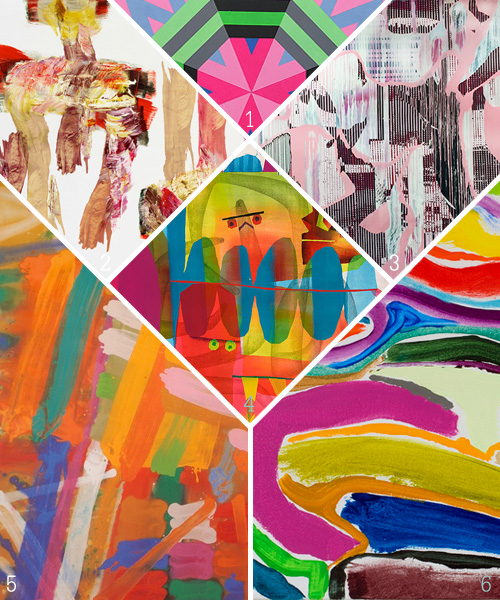
1. Carl Cashman creates vibrant neon colored op-art, a genre he has coined “neometry”, or neon geometry. The works are hypnotic, at times bordering on the hallucinatory, and blur the distinction between digital and analogue forms at Thinkspace Gallery
2. Different cycles of Pia Fries paintings between 2006 and the present day at Mai 26 Galerie
3. Working from traditions of painting, the artists in this show use the formats of painting to explore a diverse range of themes related to contemporary American culture. These include leisure culture, personal histories, queer identity, and the nature of perception at Ortega y Gasset Projects
4. With his newest series of paintings Tim Biskup has come back to his roots. The work is bold, colorful, cartoony and emotive. He’s always felt a sort of spiritual connection to the work of Roberto Matta which is a touchpoint in this collection. Like Matta, Biskup believes that these paintings are biomorphic representations of the artists psyche at Kong Art Space
5. Painting the Human Spirit is a memorial exhibition dedicated to the memory of Albert Irvin, recently deceased. Irvin’s passionate abstraction is well recognized and the artist himself, known to all as Bert, was a universally admired and loved human being at Gimpel Fils
6. For Martin Creed, there is no border between life and art. He is increasingly interested in the performative nature of painting and the particular relationship between a body’s movements and the shapes it produces. In this exhibition, certain works have been made working with dancers whose movement, with paintbrushes held in their feet, translates directly as the forms produced on the painting at Hauser & Wirth

Tuesday's Gallery Picks


gallerypicks_patternpulp122

This week’s artists are driven by their curiosity about the world and methods of perception.

*            *            *

1. Gergö Szinyova’s latest work, the industrial hues of grey, ochre, violet and spearmint reflect on the imagery that influence his painting, gathered from browsing the internet for photographs of modernist environments. The artist translates the experience of browsing, and the urban human environment, as an abstracted memory of kinetic gestures and hidden content at Anat Ebgi
2. Ruth Tabancay’s latest work spins the hexagonal form into various configurations and renders them in a range of materials that correlate to the concepts of the finished work. Tabancay is driven here by a childlike fascination with geometry, and an educated intellectual curiosity about microbiology at Mercury Twenty
3. Broken Colours features six artists whose works employ color as a near material.  It considers how a schismatic chromatic composition might lead to an integrated structural form, and vice versa at Nicholas Metivier Gallery
4. Liz K. Miller has created a new language to communicate musical scores to produce the intricate etchings and prints presented in this exhibition. The premise for these works is the use of the repetitive motifs that occur in music in order to generate concentric patterns. The resulting imagery looks like it could have naturally occurred or grown, like constellation patterns or rings of a tree at BEARSPACE
5. While many former graffiti artists drop their pseudonyms when they enter the world of art, Jason Williams (aka Revok) refused. In Revok, he goes beyond the self to examine perceptions of consciousness and unconsciousness at Ruttkowski;68
6. Inspired by his Brazilian heritage, Fernando Chamarelli channels the disparateness of his cultural environment through his work, tapping into his country’s rich history of contrasts and coexisting diversities at Thinkspace


Tracking Repetitive + Awesome.
On Instagram.