Pattern Pulp

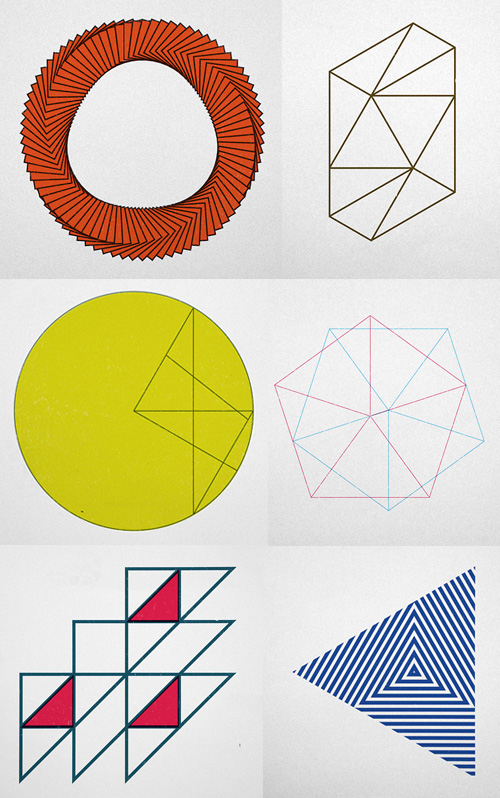
Repetition Elsewhere: Geometry Daily


When’s the last time you were given a bag of tanagrams and ask to build something?  Kindergarden? Today’s feature is devoted to the art of geometry and the manipulation that accompanies graphic design. The shapes from Geometry Daily have a whimsy to them that bend the rules. Each color combination is mathematical in a whimsical way. Have a look!


Friday Quick Links!


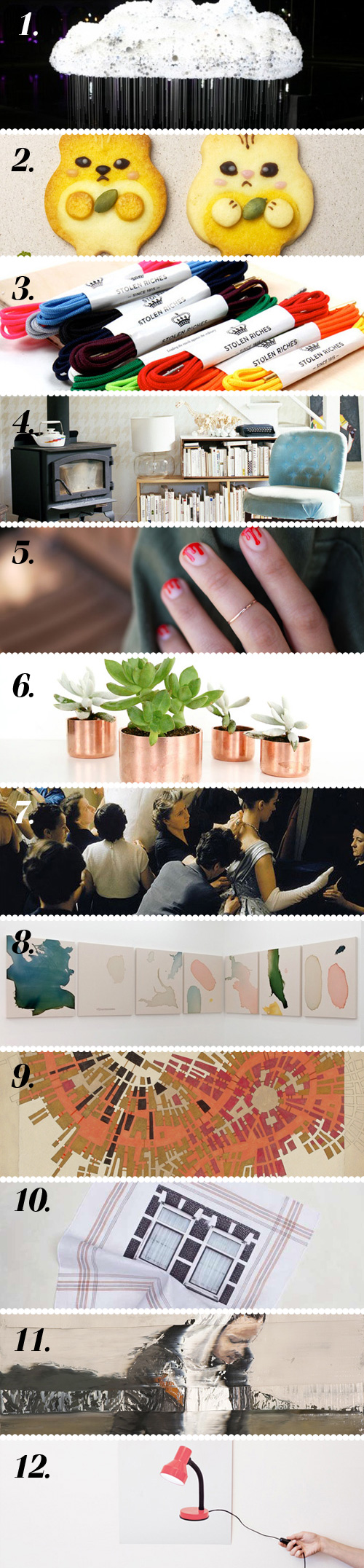
1. Delightful interactive cloud installation via Jeannie Jeannie
2. These Japanese treats are almost too cute to eat! via The Jealous Curator
3. Silver-tipped brightly colored laces to punch up any pair of shoes via Plenty of Colour
4. Hand stenciled houndstooth – talk about patience! via design*sponge
5. Give yourself drippy nails for Fall via Honestly WTF
6. Adorable DIY mini copper planters via Poppytalk
7. Stunning work by legendary photographer Mark Shaw via Miss Moss
8. Landon Metz’s simple and elegant paintings via Arthound
9. Imaginary maps of nonexistent cities via Patternbank
10. Well, aren’t these photographic hankies adorable via Design for Mankind
11. Captivated by Andy Denzler’s “disturbed screen effect” paintings via Trendland
12. Posters that are more than they appear via Design Crush

Contributed by Emily Gup

Kaleidoscopic Styles on Film


Have you heard of Matt Sundin? This film is a delicate window into his artistic style. Sundin shoots video while simultaneously shooting stills. The results are soulful and the emerging and disappearing shapes speak to the ever-present kaleidoscopic theme that’s been a fashion mainstay over the past year. Camille Mervin-Leroy is the star and the styling is by Meagan Camp.

After watching Gia Coppola‘s presentation a month ago, and Barney’s autobiographical model stories a month before that, it really got me thinking about film, and the soulful narrative it should emit. I realize this is an obvious point, though when you think of fast fashion and consumerism, there’s often a mental roadblock. In the age of social media where bloggers and click-through rates rule, the industry grips to the most shareable, trend-worthy topics: internet memes and viral pop songs. This piece is a nice reminder that an abstract, artistic work can make a similarly strong impression.

Do Photo Restrictions Fuel Creativity?


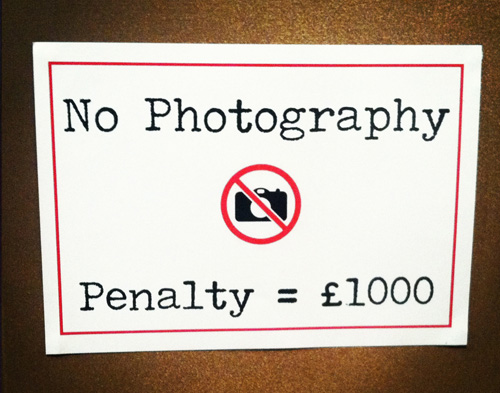
This sign felt like a dare. I had to snap it. Was it art? A threat? Both? It was hanging at the entrance of Selfridges’s holiday retail art and pop up shop last year. It’s relevant today, as it succinctly illustrates the ongoing battle between the creative world, it’s observers, inspiration, and the act of plagiarism.

How many times have you ignored a ‘no photo’ sign? It almost feels like you’re getting a pass when you snap an ‘amateur’ photo with a smart phone, rather than a professional camera. There’s no doubt about it, the landscape of photography has shifted, with more photos being taken than ever before in 2011 alone. For the creative class – or for anyone who considers themselves to be strongly visual – having such easy access to instant-gratification feels essential.

It used to be that sketchpads and a set of Staedtlers were the primary tools in our toolkit. However, now that we all carry cameras, the photo almost feels like the lazy man’s approach to memory. We’re all guilty, who wouldn’t want an authentic image of the thing that caught our eye, un-meddled by memory or drawing skills?
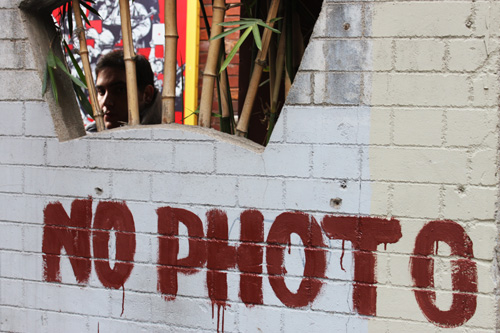
I shot this while in Shanghai last year. It almost seems a bit ironic, though the corredor of artists  were a refreshing bunch. So this leads me to ask, does the ease of smart phone photography fuel or hinder our creativity? Both perhaps? Does a photo intensify a memory or dilute the activity?

I don’t know about you, but I have some wonderfully lush memories and quickly drawn notes from events I had, at the time, desperately wished to photograph. For years, it broke my heart a little to not have pictures, but more recently I’ve realized that your imagination will never fail you and illustrating memories is a nice exercise for the brain.

As creatives, the issue almost seems a bit hypocritical.  While I don’t believe any of us would pass on the photographic progress we’ve made over the years, we’re more concerned than ever about credits and rights management of the work we’ve dedicated our lives to.  It’s no secret to anyone that social media that the lack of proper attribution, copyright infringement and outright theft has risen along with smart phone photography and the subsequent popularity of instagram, tumblr, Pinterest and the like. So, where do we draw the line? Would love to hear your thoughts.

Written by Shayna Kulik & Emily Gup

 

Resource & Swatch Inspiration


If you’re in the New York area experiencing this dreary afternoon, you might find a little joy perusing the Design Center at Philadelphia University’s tumblr.

I stumbled upon it thanks to Ana Montiel’s gorgeous blog, and found myself digging deep, wading through swatch after swatch. The above pattern is brilliantly simple- it merges pointillism and geometric sewing textures.

The blog houses 200,000+ objects related to textiles and fashion, ranging from plaids and conversationals to animated gifs and embroideries.

The scans are pretty interesting, as you can see the pencil marks, stains and cataloging system that’s been implemented over time…at least prior to the internet.

Have a look and let us know which ones you love.


Alison Jardine


Artist Alison Jardine grew up in the UK and spent a considerable amount of time traveling around the country and throughout Europe, working primarily as a writer and editor. It wasn’t until 2004 when she moved to Texas with her husband and twin daughters that she started to seriously pursue art. Since the early days, Alison has exhibited her work in a number of galleries with a core interest in nature, inspired by the idyllic setting of her childhood and the Chinese and Japanese philosophic traditions of the Sublime in nature.

Over the past few years, pixels and the effects of digitalization on imagery and perception have become an additional inspiration for her work:

“Whether stored in our biological memories, or stored as a photograph on a computer, our memory is changed by a complex interaction of our physical biology, as well as our emotional reaction and our personal narrative. In addition, the method of storage enacts its own changes, whether pixelated and compressed, or made hazy and indistinct by time.

Any artist’s work reflects their own environment, and mine exists exactly where I do: within nature, and inevitably within the digital media that surrounds us, and both these worlds are made of light, the unifying motif of my artworks.”

Tracking Repetitive + Awesome.
On Instagram.