This week’s artists examine the psyche and culture’s impact on how we see the world.
* * *
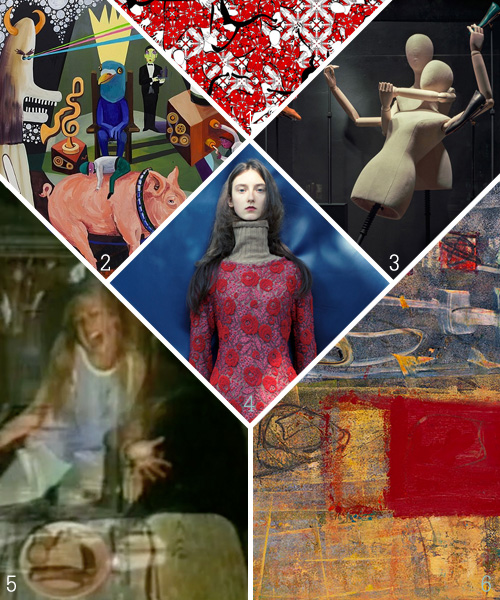
1. Parastou Forouhar’s practice examines the power structures within certain authoritarian political systems, with particular attention to how they block oppositional discourse from entering the public sphere and the partial invisibility of women through veiling. Through her work, she processes very real experiences of loss, pain, and state-sanctioned violence through animations, wallpapers, flip-books, and drawings at Pi Artworks
2. Stefanie Gutheil has delved deep into the recesses of her imagination and emerged with a phantasmagoric stable of characters à la a secularized and hallucinatory version of Noah’s Arc. With this herd of misfit creatures, Gutheil has left normality at the door and transformed the gallery into a sanctuary of the bizarre – a surreal, utopic landscape of chromatic and psychological vibrancy. In their peculiar features and with their hearts on their sleeves, Gutheil’s oddballs all emit a vaguely familiar sense of the folkloric, as if the artist unraveled them from traditional fables and stitched together her own at Mike Weiss Gallery
3. Brian Ulrich’s new body of work that reveals the excesses of luxury consumerism and America’s love affair with perception of wealth at Robert Koch Gallery
4. Characterized by her exquisite use of light, formal elegance, and palpable psychological tension, Helen Van Meene’s depictions of girls and boys on the cusp of adulthood demonstrate a clear aesthetic lineage to seventeenth-century Dutch paintingat Yancey Richardson
5. A prolific artist who lived between New York and London, Ellen Cantor combined ready-made materials with diaristic notes and drawings to probe her perceptions and experiences of personal desire and institutional violence at The Watts Institute
6. Lisa Pressman believes her paintings embody a visual synthesis of stored memory – a metaphorical representation of the passage between human vibrancy and entropy at Causey Contemporary